
AI agent development cost has two parts, a one-off build and a monthly model bill that rises with every run. Australian providers quote anywhere from about AUD 3,000 to 600,000 for the build and rarely show the data behind it. This guide splits cost by agent type, explains what drives the build price, and prices running costs from official token rates. It also compares buying a platform with building, and ends with a capped pilot.
AI agent development cost by agent type
Quoted by Australian providers, a single-task assistant starts at about AUD 3,000 and runs to AUD 10,000. A workflow agent is quoted at roughly AUD 15,000 to 40,000, and a multi-agent system at AUD 40,000 to 80,000 or more. These ranges rarely cite data, so treat each one as a vendor estimate.
Check the currency and tax before comparing any two quotes. Some pages price in AUD and others in USD, and a USD figure converts to about 1.5 times as many Australian dollars. Ask whether GST is included.
| Agent type | What it does | What it connects to | What pushes cost up |
|---|---|---|---|
| Single-task assistant | Drafts or answers for one task, such as summarising a document | One or two systems, often read-only | Document volume and the quality of source data |
| Workflow agent | Plans steps and uses tools to finish a process, such as intake triage | Several business systems, with permission to write | Integrations, approval steps and testing |
| Multi-agent system | Several agents split a task and check each other's work | Many systems and shared data | Coordination logic, evaluation and token use |
Each row costs more than the one above because it makes more decisions on its own. The guide to agentic AI versus generative AI explains that difference, and it decides which row your project needs.
What drives the build cost
Two agents that look alike on a slide can differ several times in price. The gap usually comes from the work around the model, not the model itself.
- Integrations: Every system the agent reads or writes needs a connection, permissions and error handling, and each one is separate work.
- Data preparation: Agents act on whatever data they receive, so messy or scattered records must be cleaned and structured first.
- Guardrails and human approval: Rules on what the agent may do, and who approves unusual actions, add design and build effort.
- Evaluation and testing: A set of real cases, with expected answers, must be built and rerun after every change.
- Security and permissions: The agent should hold only the access its task needs, which means roles, secrets handling and review.
- Logging and observability: Recording every step and tool call lets a person audit what the agent did and why.
- Autonomy: The more steps the agent takes without a person, the more testing and safeguards it needs.
Australia's Guidance for AI adoption from the National AI Centre turns several of these into expected practice. It sets out accountability, test and monitor, and human control as core practices. In practice that means a named owner, testing before launch, monitoring after it, and override points for a person. The guidance is voluntary and has no dollar figures, but each practice is a task a quote should price.
An ERP replacement shows how integration effort grows when many modules must work together. Enosta's project below was not an AI agent build, yet the same effort applies to agent connections.
Evaluation and guardrails are the lines most often missing from a low quote. A cheap quote that omits them may cover the demo but not the production system, and the gap returns later as change requests.
Choosing the first process matters as much as the build. Ranking candidate processes by value and risk before any code is written keeps the budget away from an agent that saves little.
Know which AI use case pays first
AI Strategy: Audit and Roadmap ranks AI opportunities by value and risk and hands over a costed 90-day roadmap.
What an AI agent costs to run
Anthropic pricing and OpenAI pricing both bill per million tokens, with a separate input price and output price. Tool charges, such as web search, come on top. Anthropic's pricing page, checked on 25 November 2026, lists Claude Haiku 5.5 at USD 0.10 input and USD 0.50 output. Sonnet 5.5 is USD 2 and USD 10, and Opus 5.5 is USD 4 and USD 20, for prompts up to 100,000 tokens.
OpenAI's API pricing page, also checked on 25 November 2026, lists gpt-6-luna at USD 0.10 and USD 0.50. It lists gpt-5.6-sol at USD 4.00 and USD 20.00. Rate cards differ by a factor of tens between small and flagship models. Prices change often, so recheck them before you budget (checked 25/11/2026 for this guide).
This is a hypothetical illustration, not a quote. One run uses 30,000 input tokens and 3,000 output tokens across all its model calls, and the agent runs 5,000 times a month. USD converts to AUD at 0.6627 USD per AUD, the RBA exchange rate on 24 November 2026.
| Model (illustration) | Cost per run (USD) | Monthly cost (USD) | Monthly cost (AUD) |
|---|---|---|---|
| Claude Haiku 5.5 | 0.0045 | 22.50 | about 34 |
| Claude Sonnet 5.5 | 0.09 | 450 | about 679 |
| Claude Sonnet 5.5, batch pricing | 0.045 | 225 | about 340 |
| Claude Opus 5.5 | 0.18 | 900 | about 1,358 |
Batch pricing halves the Sonnet 5.5 figure to 0.045 per run. On this token mix, Opus 5.5 costs 40 times as much per run as Haiku 5.5 (0.18 divided by 0.0045). Tool calls add their own charges: web search costs USD 10 per 1,000 searches, so two searches per run adds USD 100 a month, about AUD 151. Newer models also use a tokenizer that produces about 30 percent more tokens for the same text.
Anthropic's engineering team reports about 4x chat tokens for a single agent and about 15x for multi-agent systems. On that basis, a multi-agent system uses roughly 3.75 times the tokens of a single agent. That ratio is an estimate derived from the two figures.
Multi-agent systems use about 15 times the tokens of a chat, against about 4 times for a single agent, so run cost grows quickly with design.
Source: Anthropic Engineering, 2025
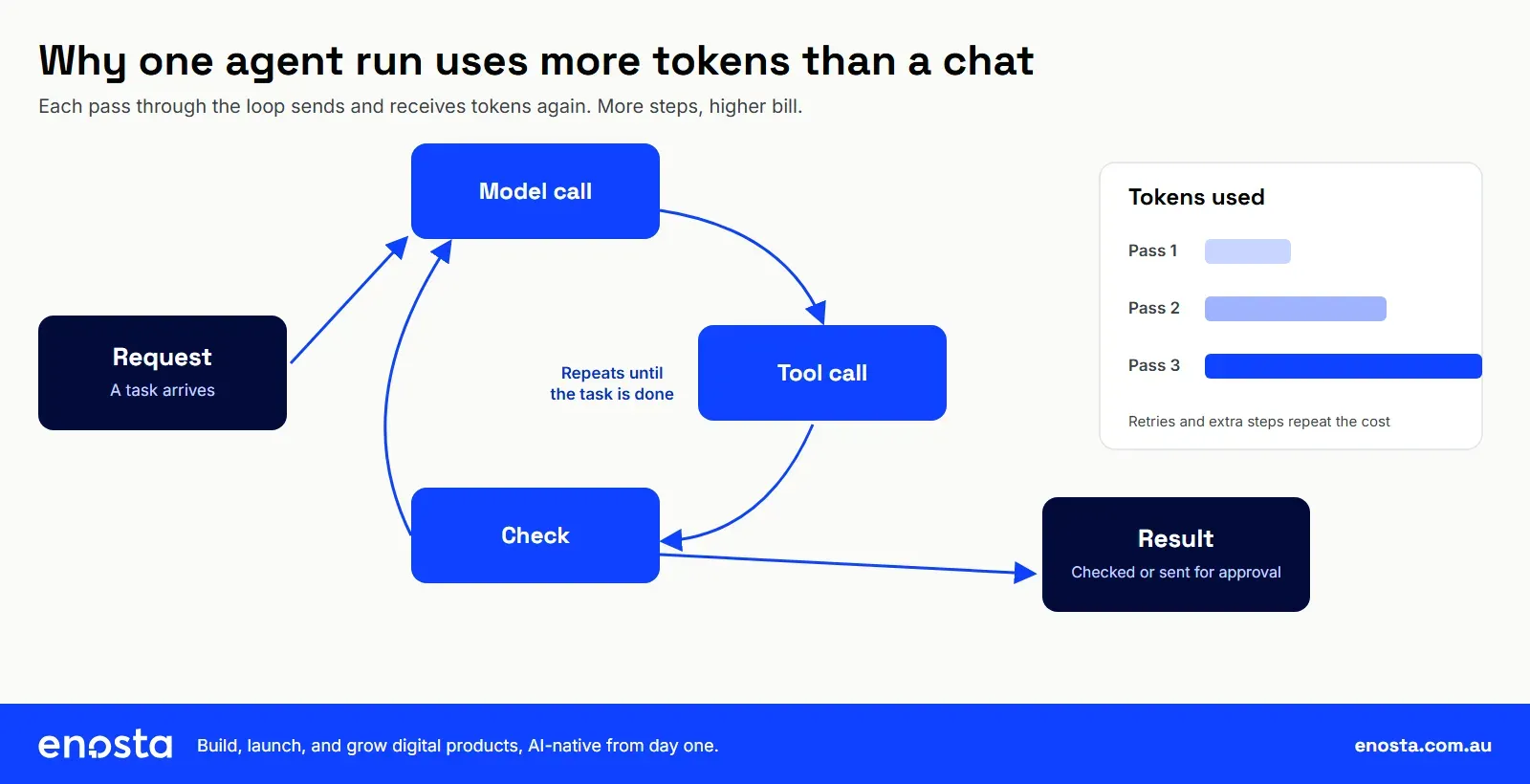
The reason is the loop. Each pass through model call, tool call and check adds input and output tokens, and a retry or an extra step repeats the cost. Run cost therefore depends on how many steps a task needs, not only on how many tasks arrive.
Other running costs sit beside the model bill:
- Hosting: The agent and its connectors run on cloud infrastructure that is billed monthly.
- Monitoring: Alerts on errors, spend and unusual actions need a person assigned to respond.
- Maintenance: Connected systems change their interfaces, and each change can break a tool the agent calls.
- Prompt and model updates: A new model version needs the evaluation set rerun, and prompts often need adjusting.
- Price changes: Vendor price changes are common, so budget a rate-card review each quarter.
Three levers cut the model bill without changing the task:
- Batch pricing: Work that can wait, such as overnight reports, costs 50 percent less on both providers.
- Prompt caching: Cache reads on Sonnet 5.5 cost USD 0.10 per million tokens, against USD 2 for fresh input.
- Smaller models for simple steps: Route routine steps to a cheaper tier and keep the flagship for hard decisions.
Each tool call also returns text that the model must read, so a tool that returns long documents raises input tokens on the next step. Trim tool outputs to the fields the agent needs.
Ask your accountant how GST applies to invoices from offshore model providers.
Buy a platform or build your own
Off-the-shelf agent platforms and automation tools are cheaper to start and slower to fit. A custom build costs more upfront and gives data control, flexible behaviour and ownership.
| Option | Upfront cost | Running cost model | Control and data | Fits when |
|---|---|---|---|---|
| Agent features in tools you already use | Lowest | Per seat or per plan | Limited to the vendor's settings | The task sits inside one tool |
| Automation platform with AI steps | Low to moderate | Per task, run or seat | Moderate, with vendor lock-in | Several tools must pass work to each other |
| Custom agent | Highest | Model usage plus hosting and upkeep | Full control and ownership | The process is core, sensitive or unusual |
Per-seat pricing grows with headcount and task pricing with volume, while a custom agent's running cost follows token use. Which is cheaper over time depends on volume and how much the workflow changes.
Platforms hide costs in seat counts and add-ons, while custom builds hide them in upkeep. Ask each vendor for the cost at double your expected volume, and compare that figure, not the entry price.
Starting on a platform and moving later is a sound path. Keep your prompts, test cases and data exportable, so the move rebuilds the connections and not the thinking. The AI workflow automation guide covers the platform route in more detail.
Pilot first, then read the quote
Oxford researchers found an average cost overrun of 27 percent across 1,471 IT projects, in an analysis published in 2013. That sample is dated and covers IT projects in general, not AI. It still argues for a capped pilot and a contingency line.
Write the stop rule down before the pilot starts. For example, end it if monthly model spend passes the cap or reviewers reject too many outputs, using thresholds your team sets.
Run the pilot in five steps:
- Pick one workflow with a clear start, end and owner.
- Set a spend cap and one success measure before building.
- Keep human review on every action that changes data or contacts a customer.
- Run it for a fixed period against a saved set of real cases.
- Apply the stop rule: scale it, fix it or end it, and record why.
A quote for a full build should show its working. Look for these lines:
- Model cost assumptions: Tokens per run, runs per month and the model tier, so you can recalculate the bill.
- Evaluation set: Who builds it, how many cases it holds, and how often it is rerun.
- Guardrails: Approval points and limits on what the agent may do.
- Monitoring: What is tracked after launch and who responds.
- Handover: Documentation and training for your team.
- Ownership: Who owns the code, prompts and cloud accounts.
Proving an idea before funding the build is how the LaKar project began. It was not an agent project, but it shows the same order of work.
Enosta delivers this through Agentic Workflow Automation, and starts with AI Strategy: Audit and Roadmap when the first use case is unclear. Clients own the code, documents and cloud accounts from day one, and a fixed quote arrives within 48 hours.
Cap the run cost of your first agent
Agentic Workflow Automation keeps a person on approval for anything unusual and logs every action, with a fixed quote within 48 hours.
Frequently Asked Questions
Do we need to fine-tune a model for our agent?
Usually not for a first version. Most workflow agents start with a general model, clear instructions and tool access.
Fine-tuning adds data preparation, training and retesting each time the base model changes. Consider it later, only if your evaluation set shows a gap that better instructions cannot close.
What happens to our costs when model prices change?
Your monthly bill moves with the rate card, and the figures in this guide were checked on 25 November 2026. A model upgrade can also raise cost through a different tokenizer.
Design for change: keep the model swappable, use batch and caching where they fit, and set spend alerts.
Can we start on a platform and move to a custom agent later?
Yes, and it is a common path. Keep prompts, test cases and data in formats you control.
Migration then rebuilds the integrations and approval flow, not the logic you already proved. Lock-in comes from workflows stored only inside the vendor's tool.
Is a chatbot priced the same way as an AI agent?
No. A chatbot answers one message at a time, so cost follows conversation volume.
An agent loops through tools and checks, so it uses several times the tokens per task and needs integrations, approvals and logging. Budget it as a workflow, not as a chat window.