

The core difference in agentic AI vs generative AI is that generative AI creates content when you prompt it, while agentic AI acts toward a goal. An agent plans the steps and works through your systems, usually with a generative model inside, so the two are partners rather than rivals. This guide compares them, shows how an agent works and gives examples by business function. It ends with a test you can run on one workflow.
How agentic AI differs from generative AI
The main difference is the job each one does. Generative AI produces an output when someone prompts it. Agentic AI pursues a goal, which means it decides the steps, uses tools and checks its own progress. Agentic AI is not a separate kind of model. It usually wraps a large language model with a goal, tools, memory and limits.
What generative AI does
Generative AI is reactive. A person writes a prompt, and a model such as a large language model returns text, code, an image or a summary. The model does not act on the result. The person reads it, edits it and decides what happens next.
What agentic AI does
Agentic AI is proactive. A person sets a goal, such as "resolve this refund request", and the system plans the steps. The large language model acts as the reasoning engine. It calls tools such as a CRM, an ERP or an API, keeps a memory of what it has done, and asks a person when it reaches its limits.
Key differences side by side
Most business differences come down to who drives the work and what a mistake costs.
| Factor | Generative AI | Agentic AI |
|---|---|---|
| Purpose | Create content from a prompt | Complete a goal across several steps |
| User role | Writes prompts and reviews every output | Sets the goal and limits, approves key actions |
| Output | Text, images, code or summaries | Completed actions, such as an updated record or a sent follow-up |
| Autonomy | Reactive: responds when prompted | Proactive: plans and acts within set limits |
| System access | Usually none beyond the chat window | Connected to a CRM, ERP, email or database through an API |
| Memory | Context of the current conversation | Memory of past steps and results across a whole task |
| Main risk | Informational risk: wrong or made-up content | Operational risk: a wrong action on a live system |
| Running cost | One model call per prompt | Many model calls and tool calls per task, plus integration and monitoring |
Think of autonomy as a dial, not a switch. At one end a person approves every step. At the other end the agent acts alone inside the limits you set.
Most business agents should start near the first end. Move the dial only when the action log shows the agent is reliable on real cases.
How an agent puts generative AI to work
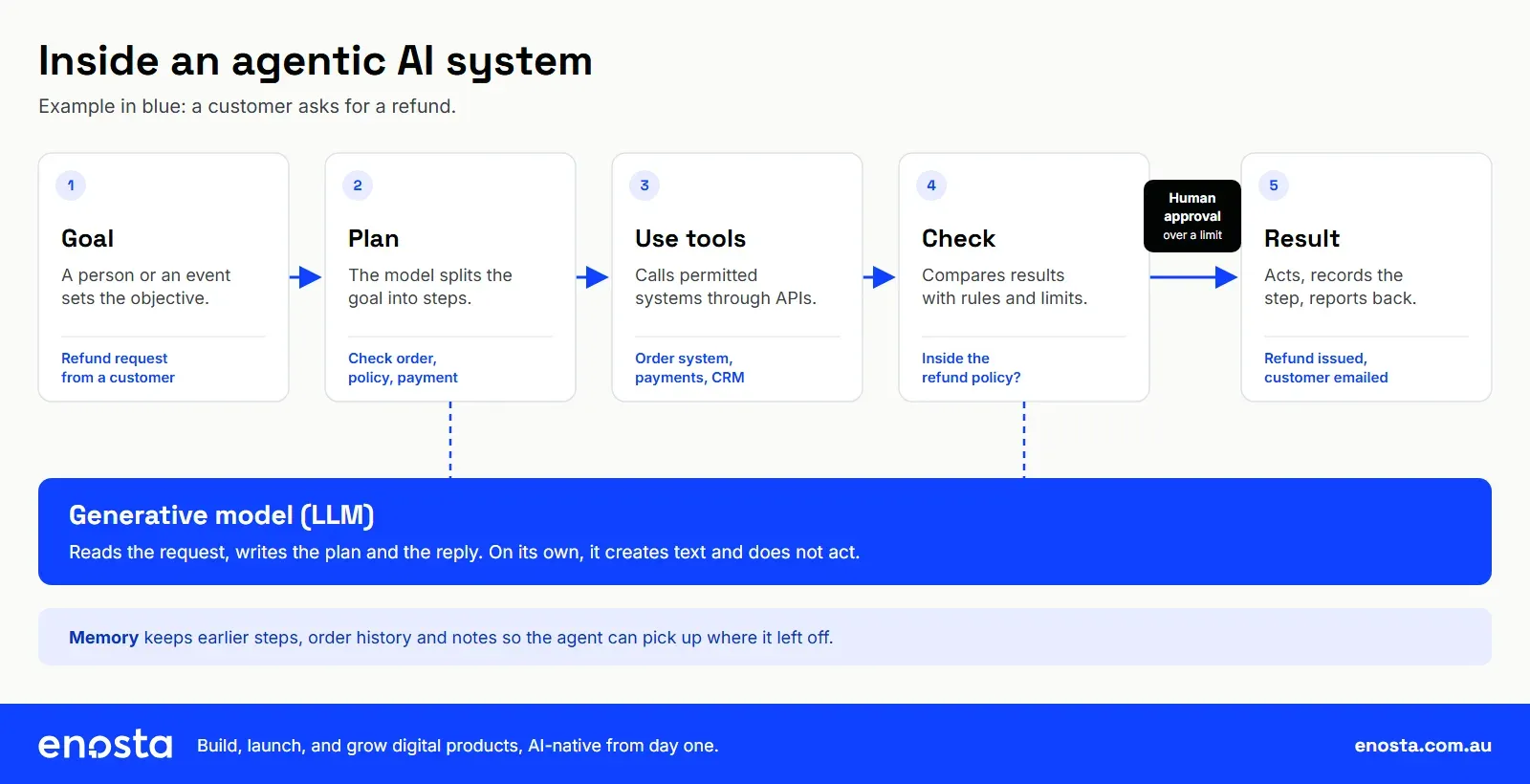
An agent wraps a generative model in a loop. The model does the reasoning and the writing. The loop gives it a goal, tools, memory and a rule for when to stop and ask. A typical run has six parts:
- Goal: A person sets the objective and the limits, such as which systems the agent may touch.
- Planning: The model breaks the goal into steps and decides the order.
- Tool use: The agent calls tools, such as an API or a connector built on the Model Context Protocol (MCP), a common standard for linking models to tools and data.
- Check: The agent compares each result with the goal, then retries or changes the plan.
- Memory: It keeps context, such as what it has already tried, so it does not repeat steps.
- Human approval: When an action passes a set threshold, or the agent is unsure, it hands the case to a person.
IBM Technology explains how generative and agentic AI work together (April 2025).
A customer refund request shows the difference. This is a typical setup, not a client case. With generative AI alone, the model reads the message and writes a draft reply. A staff member then checks the order system, decides on the refund, issues it and sends the follow-up.
With an agent, those steps run as one job. A typical setup looks up the order, checks the refund policy, issues a refund under an agreed limit, sends the reply and logs a follow-up task. Anything above the limit goes to a person with the case already prepared.
Find which workflows suit an agent
A short call with a team that runs AI agents in its own delivery helps you shortlist the workflows worth automating.
Where familiar AI tools fit
Is ChatGPT generative or agentic? The chat itself is generative AI. The label depends on the setup, not the brand. ChatGPT and Claude both offer features, such as agent mode and connected apps, that browse, run code or act inside your accounts. Switch these on and the same product behaves agentically.
Three related terms often come up alongside the two:
- AI agents: An AI agent is the software that does the acting, while agentic AI describes the approach. Agents versus agentic AI has its own guide.
- Predictive AI: Predictive AI forecasts outcomes from past data, such as demand or customer churn. It neither creates content nor takes actions.
- Robotic process automation (RPA): RPA follows fixed, scripted steps. An agent can handle variation, and RPA versus agentic AI has its own guide.
Examples of the same job done two ways
Australian SMEs mostly use generative AI today. In the National AI Centre SME AI Pulse for December 2025 to February 2026, 54% of SMEs using or planning to use AI use it for content generation. Another 54% use it for data analytics. The same report says more complex uses such as agentic AI "remain largely untapped".
Large organisations are moving faster. In McKinsey's 2026 global survey, 40% of respondents from organisations with more than US$1 billion in revenue reported scaling AI agents. Among smaller organisations, the share stayed flat at 22%.
The pairs below are typical setups, not client results. Each shows the same job done both ways.
- Customer service: Generative AI drafts a reply to a late delivery complaint. An agent checks the order and courier status, applies the compensation policy, sends the reply and updates the ticket. A support lead approves any credit above a set amount.
- Supplier invoices: Generative AI pulls the fields from a PDF invoice and summarises it. An agent matches the invoice to a purchase order in the ERP, flags differences and queues a payment draft. A finance officer approves every payment run.
- New starter onboarding: Generative AI writes a welcome message and a first-week plan. An agent creates accounts in the HR and IT systems, assigns training and books check-ins. The hiring manager confirms access to sensitive systems.
- Stock reorder: Generative AI summarises weekly sales and stock reports. An agent compares stock with forecast demand and raises a purchase request below a threshold. A manager approves orders above an agreed value.
Risks and governance for agentic AI
Generative AI mainly carries information risk. A wrong answer is a problem, but a person usually reads it before it matters. Agentic AI adds operational risk because it acts. In the same National AI Centre survey, around 65% of non-adopting SMEs cited distrust in AI decision-making or a strong preference to keep human control.
Four risks deserve a plan before launch:
- Hallucination: The model states something false, and the agent acts on it.
- Over-broad access: An agent with wide access permissions can change more than the task needs.
- Silent errors: Without an audit log, nobody can see what the agent did or why.
- Cascading actions: One wrong step feeds the next, so a small error spreads across systems.
Australia's Guidance for AI Adoption, published in October 2025, is voluntary and not legal advice. It sets six essential practices:
- Decide who is accountable.
- Understand impacts and plan accordingly.
- Measure and manage risks.
- Share essential information.
- Test and monitor.
- Maintain human control.
For an agent, those practices turn into five controls:
- Approval thresholds: Add human-in-the-loop sign-off above set values and for any action that cannot be undone.
- Least-privilege access: Give the agent only the permissions the task needs.
- Action logs: Record every tool call and decision so you can trace errors.
- Testing: Run sample cases before go-live and keep monitoring afterwards.
- Rollback: Make each action reversible, or keep it behind an approval.
Let AI act only within your limits
ISO/IEC 27001 certified delivery with human approval gates keeps an agent inside the limits you agree.
Which one should your business use?
Use generative AI when the job is to produce an output that a person reviews. Consider agentic AI when the job needs actions across several steps and systems. Most Australian SMEs are still early. The National AI Centre reported that 43% showed some level of AI adoption in December 2025 to February 2026, down from 45% in September to November 2025.
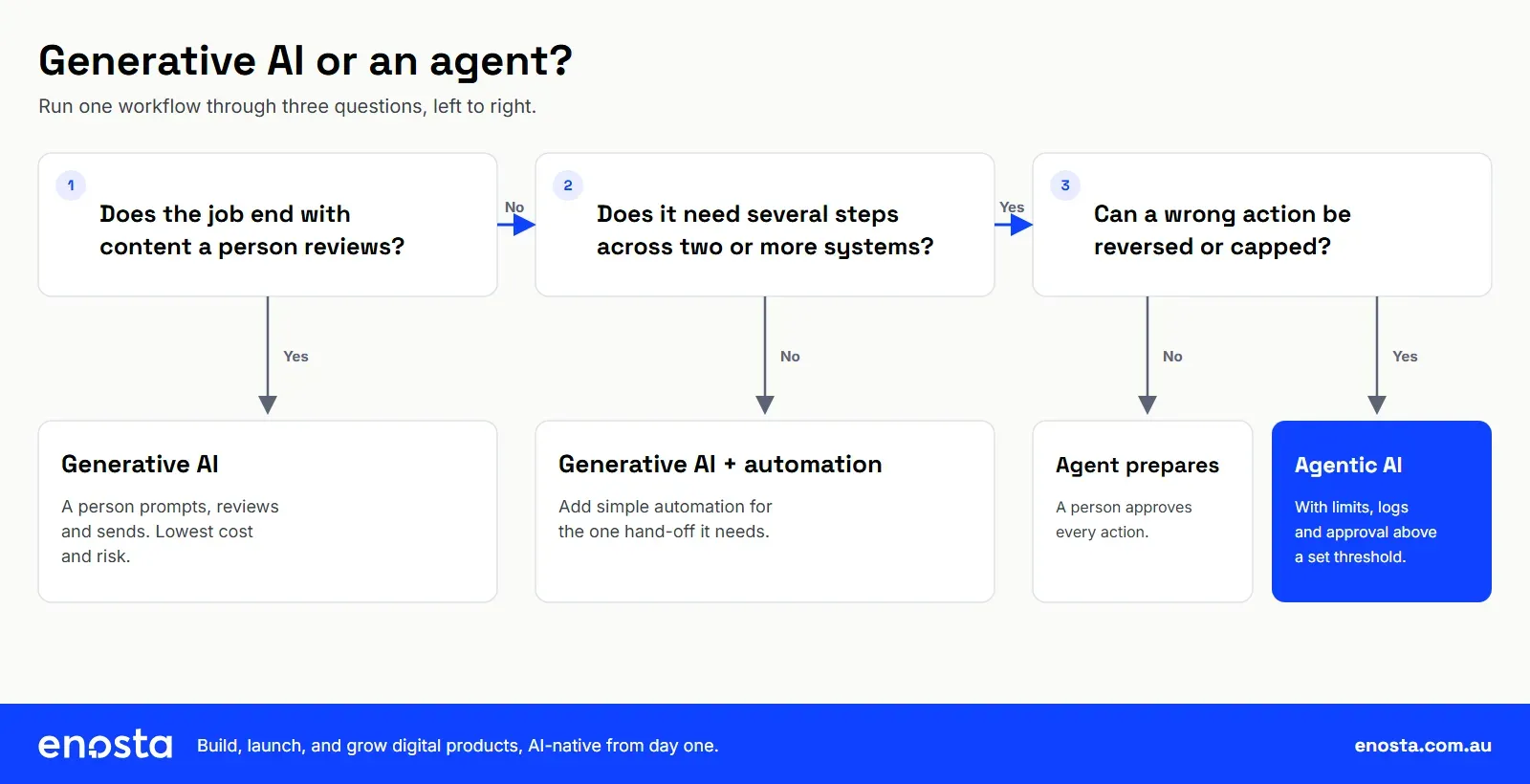
Run these yes/no questions on one workflow:
- Number of steps: Does the job need several dependent steps, not one answer?
- Number of systems: Does it read from or write to more than one system, such as a CRM and an ERP?
- Frequency: Does it run often enough to repay the setup work?
- Reversibility: Can every action be undone?
- Error cost: Is a wrong action cheap to fix?
- Approval: Can a person approve the risky steps without slowing the job to a crawl?
- Data access: Can the agent get the data it needs under least-privilege permissions?
- Budget: Can you fund inference, integration and monitoring costs?
If the first three answers are no, generative AI is enough. If they are yes, and reversibility and approval are also yes, an agent is worth scoping. If reversibility or approval is no, keep a person in the loop or stay with generative AI.
Agentic projects also carry real failure risk. A Gartner forecast from June 2025 expects many agentic efforts to end as cancelled projects by the end of 2027. It points to escalating costs, unclear business value or inadequate risk controls.
Over 40%
Gartner forecasts, rather than measures, that over 40% of agentic AI projects will be cancelled by the end of 2027.
Source: Gartner, 2025
The same Gartner release warns about agent washing, where vendors relabel chatbots and assistants as agents. It also notes that many use cases sold as agentic do not need an agentic setup. Each agent task makes many model calls too, so inference cost grows with use.
If one workflow passes the test, Enosta offers Agentic Workflow Automation for the workflow you have chosen. The work runs under ISO/IEC 27001 certified delivery, and engineers review what AI agents and copilots draft. If your use cases are not clear yet, AI Strategy: Audit and Roadmap comes first.
Scope your first agent workflow
Get a fixed quote within 48 hours for one workflow, with clear limits and running costs.
Frequently Asked Questions
Can agentic AI work without generative AI?
In a narrow sense, yes. A rules-based agent, such as a scripted bot that follows fixed conditions, can pursue a goal without a language model. Most business agents today use a large language model because it handles language and judgement calls that fixed rules cannot.
Is agentic AI more expensive to run than generative AI?
Usually, yes. An agent makes many model calls and tool calls for one task, while a prompt makes one call. Add the integration work and monitoring, and the running cost rises. Price one workflow before you commit.
Who are the "big 4" AI agents?
There is no standard list. Vendors and articles use the phrase loosely, and the names change with each ranking. Judge any product by what it can do in your systems, what access it needs and who is accountable for its actions.
Do we need to replace our generative AI tools to use agents?
No. Agents usually build on the generative models and tools you already use. Add one connected workflow with clear limits, and keep your chat tools for drafting and analysis.