

SaaS development cost in Australia depends on the stage you are funding, not on one price for the whole product. A subscription product keeps costing money after launch, because tenancy, billing and hosting grow with every customer you add. Published ranges also disagree widely, since they are estimates that rarely show their data. This guide sets a budget stage by stage, explains what makes SaaS dearer than a standard app, and shows how to check a quote against revenue.
SaaS development cost by stage
Think of the cost as three separate budgets in AUD: the MVP stage, a version that supports the first paying customers, and a scale stage. Each stage has its own scope. Funding the next one should depend on the current stage meeting a clear exit test, because one number for the whole product hides when the money is actually spent.
Ranges quoted by Australian providers for the same product size vary a great deal, and each is a vendor estimate. One lean MVP range runs from A$15,000 to A$50,000, while a full platform is quoted at A$120,000 to A$300,000. Another summary gives A$25,000 to A$250,000+ for the whole product. These pages rarely show the data behind the numbers, so treat them as vendor estimates and check what each quote includes.
| Stage | Must contain | Pushes the cost up | Move on when |
|---|---|---|---|
| MVP | One core workflow, accounts, simple admin, basic onboarding | Extra user types, custom integrations, a design that is not settled | Real users finish the core workflow without help |
| First paying customers | Subscriptions and billing, roles and permissions, analytics, support tooling | Several plans, team accounts, tax handling, customer-specific requests | Customers pay on time and renew |
| Scale | Hardened security, audit logs, stronger monitoring, performance work | Enterprise buyers, stricter data isolation, more integrations | Revenue per customer covers the cost of serving them |
Costs that are not specific to SaaS, such as hourly rates and tax treatment, are covered in our general software cost guide for Australian companies.
What makes SaaS cost more than a standard app
A standard app serves one organisation. A SaaS product serves multiple organisations at once, each with its own data, users and billing, and every one of those requirements adds engineering work.
- Multi-tenancy: The product must keep each customer's data apart while sharing infrastructure, which affects the database design, testing and every report.
- Subscriptions and billing: Plans, upgrades and downgrades, failed payments and invoices need logic that works every month, not once. Each plan change also has to adjust the next invoice correctly.
- User roles and permissions: Each customer needs its own admins and members, with access rules that hold across organisations.
- Integrations: Customers expect the product to connect to the tools they already use, and each connection needs building and maintaining.
- Security and audit logs: Larger buyers ask who changed what and when, so activity records are built in early. Procurement teams may also ask for audit evidence before they sign, which is compliance work on top of the build.
- Analytics: You need usage and revenue reporting to decide what to build next.
- Admin and support tooling: Your own team needs to see accounts, fix problems and handle refunds.
Privacy rules also shape the build. The Privacy Act covers organisations with a $3 million turnover or more per year, plus some other organisations. An early SaaS that stores personal information should confirm its position with an adviser. It should not assume it is exempt. Compliance work also depends on the data you hold, so decide the data hosting region before the first release.
The Smartos platform shows how one product grows in scope. It started as a rental management system and expanded across contracts, billing, maintenance and bookings.
Each added module meant more rules, more roles and more data to keep consistent. Budget for that pattern, because the first stage rarely stays the whole product.
Get a stage-one scope suppliers can price
Enosta runs Product Discovery and Validation to turn your idea into a written scope that every supplier can quote against in the same way.
Tenancy and billing: the two expensive early decisions
Two choices are hard to reverse once customers are live, namely how tenant data is separated and how billing works. Both are cheaper to get right in the first stage than to rebuild in the third. Neither shows up as a line on a feature list, which is why quotes often skip them.
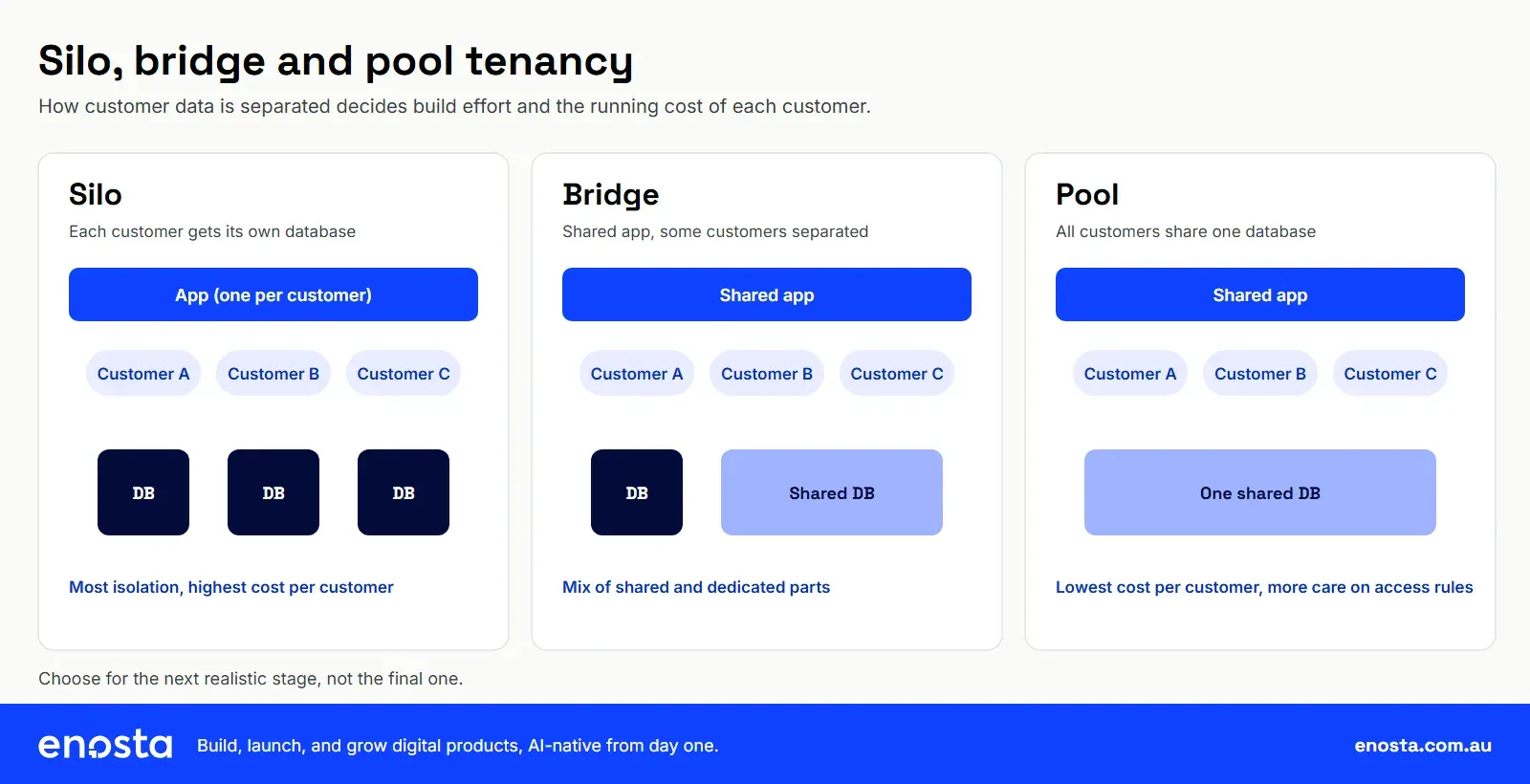
The AWS SaaS Lens describes three tenancy patterns: silo, pool and bridge. The cost directions in the table are our reading of those definitions, not figures from AWS. No primary source gives a per-tenant cost, so the table describes direction only, in words.
| Model | How data is separated | Build effort | Run cost per customer | Fits when |
|---|---|---|---|---|
| Silo | Each tenant gets dedicated resources, such as its own database | Higher, as each tenant is set up and updated separately | Higher, as nothing is shared | Strict isolation or regulated data matters most |
| Pool | Tenants share resources and are separated by the application | Higher at first for isolation logic, then lower per tenant | Lower, as shared resources spread the cost | You expect a large base of customers with similar needs |
| Bridge | Some parts are dedicated and others are shared | Highest, as two patterns must be built and run | Between the two | A few services need isolation and the rest can be shared |
Billing is both a build item and a running cost. Stripe's Australian pricing page lists 1.65% + A$0.30 for domestic cards and 0.7% of volume for Stripe Billing on pay as you go.
1.65% + A$0.30 per domestic card payment
Billing fees scale with revenue, so they belong in gross margin and not only in the build quote.
Source: Stripe, 2026
Here is the arithmetic, which is an estimate and not a published figure. On a A$50 payment, the card fee is A$1.125, about 2.25% of the payment. At A$1,000,000 of annual billing volume, the 0.7% Billing fee comes to A$7,000 a year. Rates differ by provider and plan, so check the current page.
Tax adds one more requirement. The ATO says a business must complete GST registration once its GST turnover reaches $75,000, as set out on its registering for GST page. The billing build should be ready to show tax correctly on invoices before that point arrives.
What SaaS costs to run
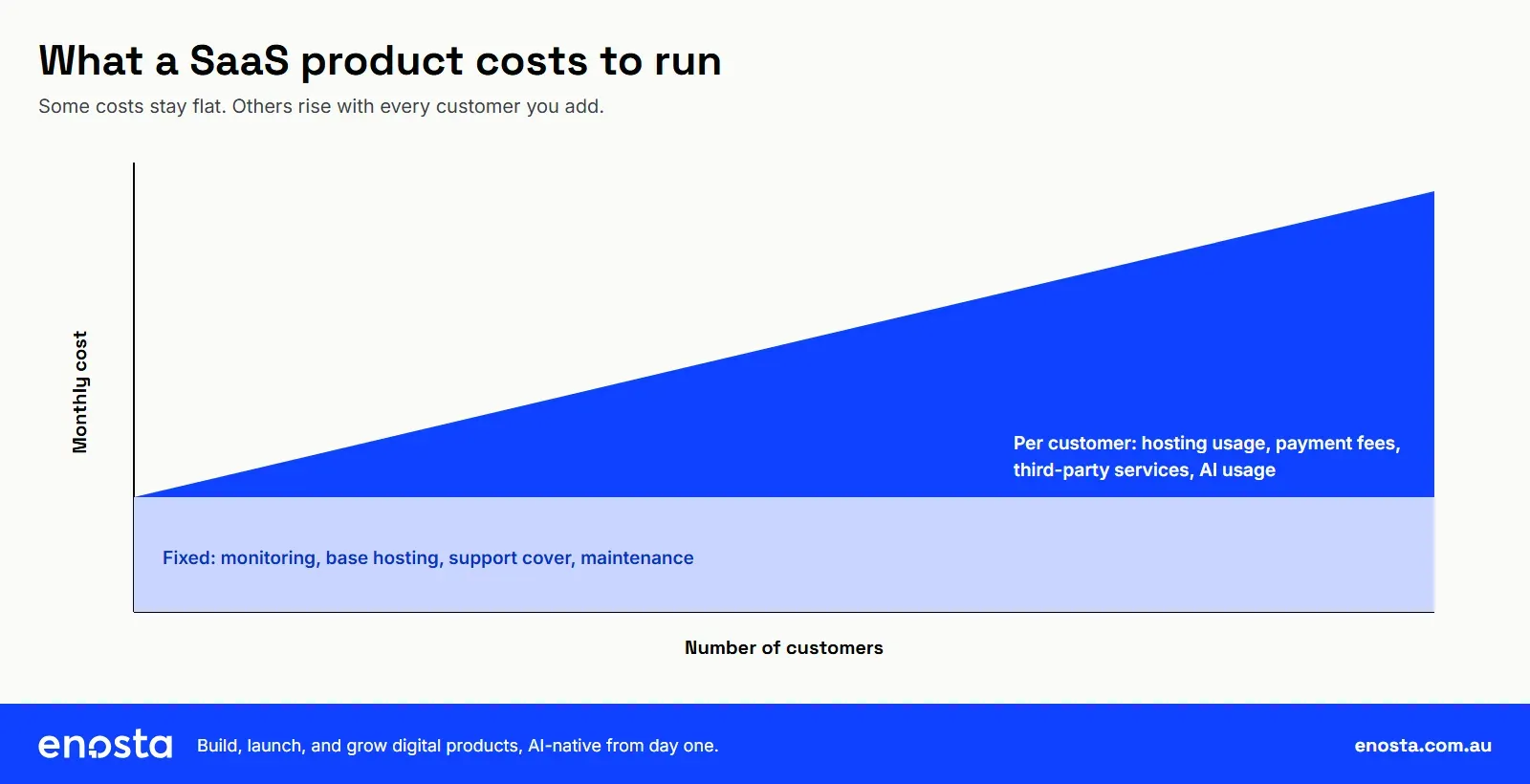
Running costs start on launch day and fall into two groups. Some stay roughly flat, and others rise with every customer you add. Separating them shows where gross margin comes from.
- Cloud hosting: The bill grows with usage and with the tenancy model. Australian-region hosting is a design choice. It can matter to customers who ask where their data sits, so settle it before the first release.
- Third-party services: Email, authentication, search and monitoring tools often charge by usage, so they rise with customers.
- AI usage fees: Any AI feature that calls a model costs money on every request, which makes it a per-customer cost.
- Monitoring and support: Someone must watch the system and answer customers, and both tasks grow with the customer base.
- Maintenance: Vendors quote 15% to 20% of the build cost per year, and others quote 15% to 25%. The disagreement shows these are estimates, not data.
The team is a cost too. For in-house developers, Jobs and Skills Australia reports median weekly earnings of $2,537 for software and applications programmers. Over 52 weeks that is about $131,900 (an arithmetic estimate).
The 12% super guarantee then adds about $15,800 for eligible employees, also an estimate. Treat this as a floor, because recruitment, tools, leave and management come on top. An outsourced or hybrid team converts part of that into a contract cost instead.
Finally, keep a contingency line. Across a study of 1,471 IT projects, the average cost overrun was 27%, so a 27% overrun is the average case, not a rare one. That sample is global and mixed, so it supports holding a reserve but not a specific percentage.
Budget against revenue, not against a feature list
A feature list tells you what to build, not whether the product can pay for itself. Sizing the budget against revenue gives you a limit that does not depend on any supplier's estimate. It also tells you the customer count the product needs before the build has earned its keep. This is a planning method, not financial advice.
- Estimate the cost to serve a customer: Add hosting, third-party fees, payment fees and support for a typical account. Use the Stripe arithmetic above for the payment line.
- Set the price: Subtract the cost to serve from the monthly price to get the margin per customer.
- Count break-even customers: Divide your fixed monthly costs by that margin.
- Set the runway: Subtract the build budget from your cash, then divide what is left by monthly spending.
- Fund the next stage only when the current stage meets its exit test: Do not release the scale budget on a forecast.
Here is a hypothetical illustration with round numbers, not a benchmark. A product costs A$100 a month per customer, and serving one customer costs A$50, so the margin is A$50. If fixed monthly costs are A$20,000, break-even needs 400 customers, because 20,000 divided by 50 is 400. With A$300,000 in cash and an A$180,000 first build, A$120,000 remains, which covers six months of those costs. If 400 customers look out of reach in that time, narrow the first stage.
Know the build cost before you commit your runway
Enosta returns a fixed quote within 48 hours, priced stage by stage, so you can line it up against your own revenue plan.
How to lower SaaS cost and read the quote
Cost falls fastest when you reduce scope before you reduce quality. These levers cut spend without weakening the product.
- Discovery first: A short validation phase removes features nobody needs before they are priced.
- Narrow MVP scope: Launch one workflow for one type of customer, and add the rest after payment starts. Every feature left out of the first stage is a feature you do not pay to build, test or maintain yet.
- Buy commodity layers: Authentication and billing are solved problems, so buy them and spend your budget on what makes your product different.
- Choose tenancy for the next realistic stage: Design for the customers you expect soon, not for the largest customer you can imagine.
Quote itemisation is what lets you compare suppliers like for like. A single total hides the choices that decide the real cost, so ask that the quote lists each of these items:
- Scope of each stage
- Tenancy model
- Billing scope
- Environments and hosting setup
- Testing
- Security work
- Support period
- Ownership of code and cloud accounts
- Whether prices include GST
Our AI-Native MVP Development service aims at a production-ready first version in 2 to 3 months, with the code and cloud accounts owned by the client from day one. Product Build and Scale then covers the work after that first release.
Reach paying customers before the scale-stage spend
Enosta's AI-Native MVP Development delivers a production-ready first version in 2 to 3 months, and you own the code and cloud accounts from day one.
Frequently Asked Questions
How much does a SaaS product cost to run each month?
It depends on customer count, tenancy model and the third-party services you use. No primary source gives a reliable monthly figure, so build your own from the cost to serve one customer and the fixed costs listed above. Quotes that show a single monthly number usually leave out support and maintenance.
Can I build a SaaS product with no-code tools?
Yes, for a first test of demand. No-code tools can show whether customers want the workflow before you pay for custom engineering. Limits appear with tenant isolation, billing logic and integrations, so plan to move the parts that matter once paying customers depend on them.
How long does it take to recover the build cost?
Payback depends on your numbers, so use the break-even method above. Divide your fixed monthly costs by the margin per customer, then estimate how fast you can reach that customer count. That gives you a payback period you can test against your runway. If the answer is longer than your runway, shrink the first stage before you start building.
Do AI features change what SaaS costs?
Yes. A model call costs money on every request, so AI features add a per-customer running cost on top of the build effort. Test them on a small group first, measure the usage cost, and price plans so the margin still holds.