

Software development cost in Australia depends on scope, integrations and the team you choose far more than on any price list. Ranges quoted by Australian development firms run from tens of thousands of dollars to well over a million, and they rarely show their data. This guide explains how a quote is built, what moves it, and what in-house, agency and offshore teams cost. It also covers running costs, ATO treatment and how to compare quotes.
How much software development costs in Australia
Custom software in Australia costs anywhere from tens of thousands of dollars for a small internal tool to well over a million for a regulated enterprise platform. Ranges quoted by Australian development firms span about AUD 15,000 to more than AUD 1,000,000, and they rarely show the data behind those numbers. Treat each one as a vendor-quoted estimate, not a market price.
Two firms can quote the same brief far apart for honest reasons. One includes discovery, testing and hosting setup, while the other leaves them out. One assumes a clear scope, while the other prices in the unknowns. Before you compare any two numbers, confirm whether each is ex GST or inc GST.
| Project type | What is usually in it | Typical delivery time | What pushes it up |
|---|---|---|---|
| Internal tool or workflow app | Replaces a spreadsheet or manual process, one or two user roles, few integrations | Weeks to a few months | More user roles, approval steps, reporting, links to finance or CRM systems |
| Customer portal | Login, customer accounts, self service, payments or bookings, an admin console | A few months | Payments, identity checks, many user types, accessibility needs |
| Business platform | Several modules, workflows across teams, integrations, dashboards | Several months, often in stages | Data migration, many integrations, custom permissions, complex reporting |
| Enterprise or regulated system | Many connected systems, strict security, audit trails, high availability | The longest of the four, delivered in phases | Compliance duties, security testing, legacy interfaces, formal change control |
The row you sit in matters less than the unknowns inside it. A portal with one payment provider and clear rules costs far less than one that must read three old databases. An enterprise system adds formal controls on top of a business platform. Mobile apps, SaaS products, MVPs and AI agents each follow their own cost patterns, so this guide stays with custom business software, the work covered by Product Build and Scale.
How a software quote adds up
Most quotes follow one formula: the number of people, times the weeks they work, times a blended rate, plus a contingency line. The blended rate is the average price of a day across designers, engineers and testers. Once you see the formula, you can test any quote against it.
Here is a hypothetical example, not a real quote. Say a team of four works for 12 weeks. That is 48 person-weeks, or 240 person-days at five days a week. Multiply by the firm's blended day rate to reach the build cost, then add contingency for what the brief does not yet show.
A quote usually spreads that effort across six phases:
- Discovery: Workshops and research turn the brief into a written scope, user flows and a prioritised backlog.
- Design: Wireframes and screens show how each workflow looks and behaves before any code exists.
- Build: Engineers deliver the product in short sprints, with reviews at the end of each one.
- QA: Testers check features, performance and security, and fix defects before release.
- Deployment: The team sets up hosting, release pipelines and monitoring, then goes live.
- Handover: Documentation, training and access transfer leave your team able to run the product.
Discovery is the phase most often skipped to win a lower headline price, and the most common reason a project later grows. Product Discovery and Validation covers this phase. Running costs sit outside the formula, so budget them as a separate line.
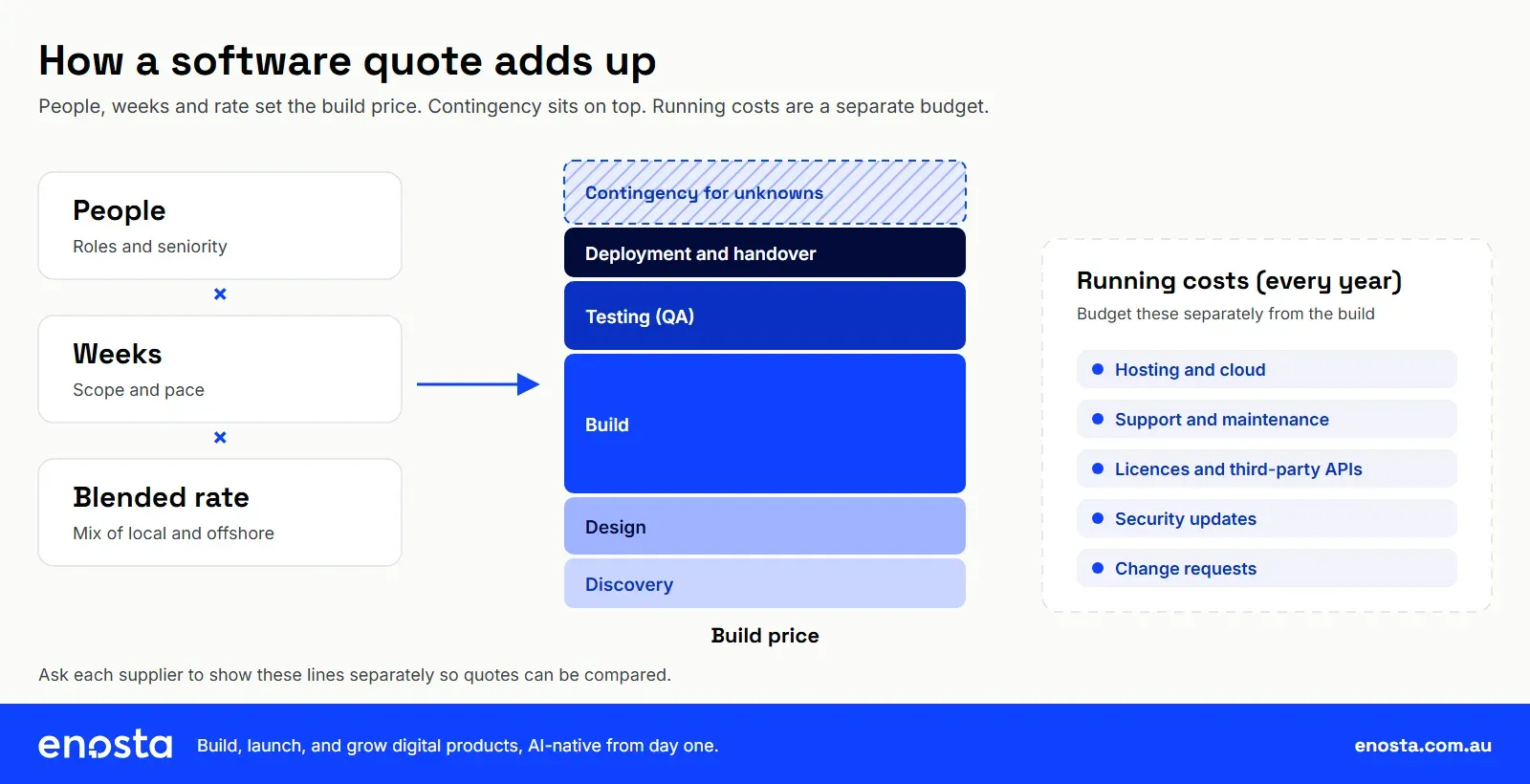
A quote you cannot take apart this way is a quote you cannot test. Ask every firm to show the team, the weeks and the assumptions behind its number.
Get a scope you can price line by line
Product Discovery and Validation turns your brief into a written scope before build, so every quote answers the same questions.
What makes software cost more
Cost rises with the amount of work, the uncertainty in it and the pressure to finish. Each driver below adds cost for a different reason, and you control some of them.
- Scope and workflows: Every extra workflow needs design, build, testing and documentation. Vague scope also hides work that appears later as change requests.
- Integrations: Each connection to a payment gateway, CRM or accounting system needs mapping, error handling and testing. Poorly documented third-party systems take longer.
- Data migration: Old data is rarely clean. Cleaning, mapping and checking it before import often takes more effort than the new screens.
- User roles and permissions: Each role changes what a person can see and do, so each one multiplies the test cases.
- Compliance and security testing: Privacy duties, audit trails and penetration testing add specialist hours and slower release steps.
- Team location and seniority: Senior engineers cost more per day but often finish with fewer defects. Time zones affect how much coordination you pay for.
- Timeline pressure: A compressed schedule needs a larger team working in parallel, and that adds management overhead.
The Loyal project shows several of these drivers at once, because a white-label booking app and a slow admin system had to be replaced together.
Replacing an existing system adds cost that a new build does not carry. Teams must understand what the old system does, including rules nobody wrote down. Legacy Modernisation work starts by mapping those rules, so the new build does not reproduce the gaps or drop a function users rely on.
In-house, agency or offshore: what each costs
Official data gives a solid floor for the in-house side, but it covers employees only. Jobs and Skills Australia reports median full-time earnings for software and applications programmers, using ABS data from May 2025.
Median full-time earnings for Australian software and applications programmers sit well above the all-occupation median of $1,852, before any on-costs.
Source: Jobs and Skills Australia, 2025
Our arithmetic shows what that means over a year. At $2,537 a week, 52 weeks come to $131,924. The super guarantee rate of 12% applies to eligible employees, which lifts the total to about $147,800. That estimate sits before leave, recruitment, equipment and management time, and the earnings data does not say whether super is already included.
Agencies and contractors price differently, and each option carries a different risk:
- Freelancer: You pay for individual skill and flexibility. The risk is dependence on one person for delivery, testing and handover.
- Local agency: You pay for a managed team, project management and local accountability. The risk is a higher day rate and a team sized to the agency's needs.
- Offshore or hybrid team: You pay for a larger team at a lower blended rate, often with a local lead. The risk is time zone gaps, so check how scope and decisions move between sites.
Any hourly rate published by an agency is a vendor figure, not official data, so ask each firm for its blended day rate in writing. Offshore teams, such as engineers in Vietnam, usually bill at a lower rate, which is why hybrid teams are common. Hiring in-house only pays off when you have steady work for several years. For a fuller guide to choosing a partner, read our piece on software development outsourcing for Australian companies.
Fixed price, time and materials or a dedicated team
The pricing model decides who carries the cost risk, so it matters as much as the headline number. Each model suits a different level of certainty about scope.
| Model | How you pay | Who carries overrun risk | Fits when | Watch out for |
|---|---|---|---|---|
| Fixed price | One agreed price for a defined scope | The firm, within the written scope | Scope is stable and well documented | Padded estimates and costly change requests |
| Time and materials | Hours or days worked, billed regularly | The client | Scope is still evolving and you want flexibility | No cap without a budget limit and regular reviews |
| Dedicated team | A monthly fee for a team working only on your product | Shared, because the team's cost is fixed but output varies | Long-running product work with a steady backlog | Paying for idle capacity if the backlog thins |
| Discovery then fixed stages | A fixed fee per stage after a discovery phase | The firm, stage by stage | Scope is partly known and you want checkpoints | Gaps between stages if scope is not agreed |
Many projects end up on the last row. A short discovery phase removes the biggest unknowns, then each stage is priced as a fixed piece of work. You keep the ability to change direction between stages, and each stage has a price you agreed before it started.
See the assumptions behind your fixed price
Enosta returns a fixed quote within 48 hours of a scoping call, and you own the code and cloud accounts from day one.
Costs after launch and the ones quotes leave out
A quote usually covers the build, but software keeps costing money after it goes live. Ask about each of these before you sign:
- Hosting and cloud: Cloud costs for servers, storage and data transfer are billed monthly and grow with usage.
- Maintenance and support: Bug fixes, small improvements and a support channel need ongoing engineer time.
- Licences and third-party APIs: Maps, payments, messaging and identity services often charge per user or per call.
- Security updates and testing: Libraries and platforms need regular patching, and some products need repeat security tests.
- Change requests: Work outside the agreed scope is billed on top, usually at the firm's standard rate.
- Data migration: Moving data between systems can sit outside the build quote.
- Training: Staff need time and materials to learn the new system.
- GST: Confirm whether each price is ex GST or inc GST, because the difference changes the budget.
Providers often quote maintenance as a yearly share of the build cost, but the guides we compared show no data for it. Ask for a written support price instead of trusting a percentage.
Budget a contingency line as well. Flyvbjerg and Budzier of Oxford studied 1,471 IT projects. They found a 27% average overrun in cost, and about one in six projects overran cost by about 200%. The data is old, global and mixed, so it supports having a contingency line, not a specific percentage.
Compare five-year cost, not the first-year price. Off-the-shelf software charges a subscription for each user, and workarounds add hidden labour. Custom software has a larger build cost and then run costs. It tends to win when your process is unusual, or when per-user fees would keep growing with your team.
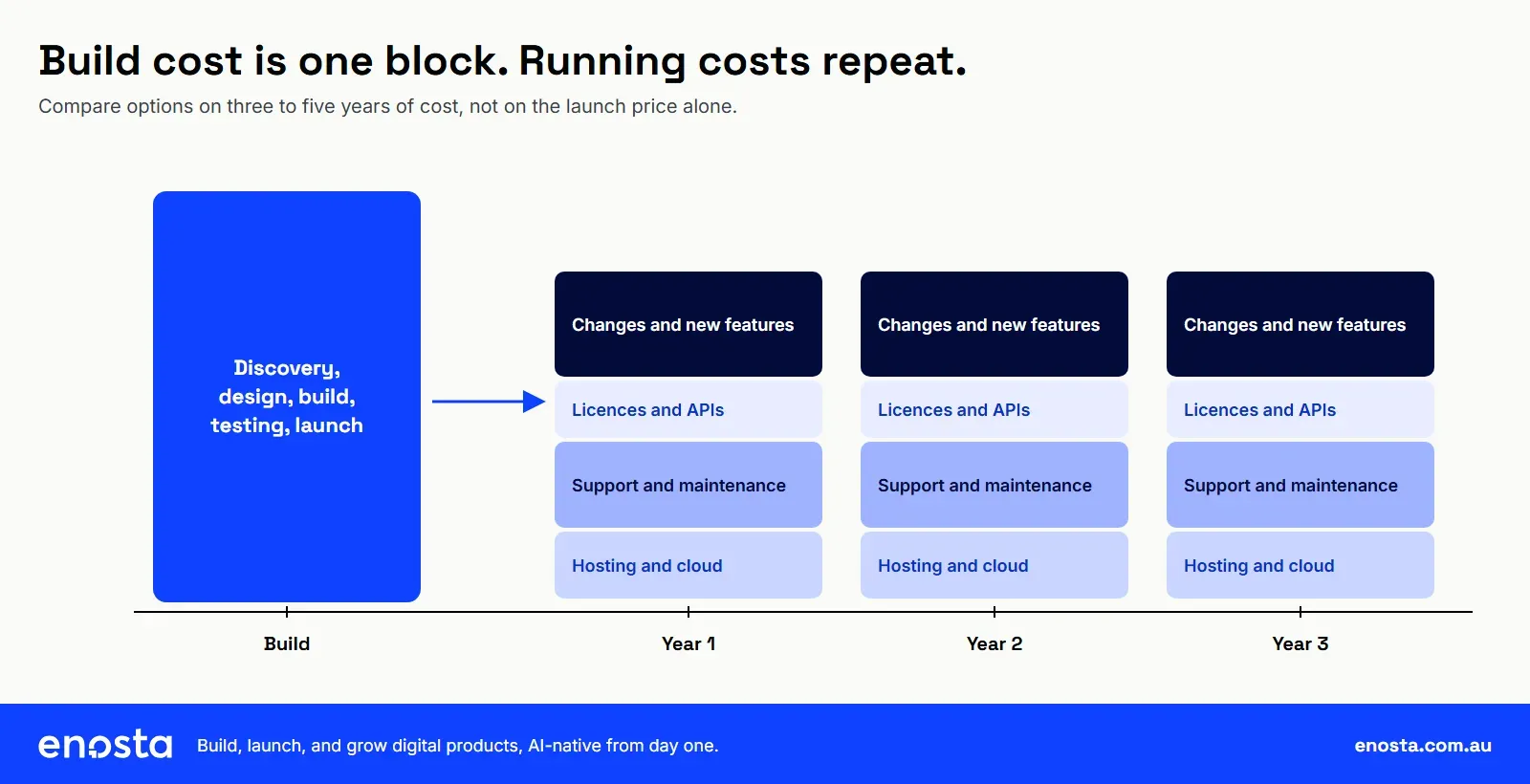
How the ATO treats software development costs
You may be able to claim the cost of building software, but usually not all in one year. The Australian Taxation Office guidance on in-house software covers software you develop, or pay someone to develop, for your own business use rather than for sale.
A small business may claim an immediate deduction if the expense falls below the instant asset write-off threshold, which changes over time, or use the small business pool. Software still in development can go into a software development pool. For spending from 1 July 2015, the deduction runs like this:
- Year 1: Nil.
- Years 2 to 4: 30% a year.
- Year 5: 10%.
Without a pool, the prime cost method uses a five-year effective life for software held from 1 July 2015. Software built for sale, such as a SaaS product, follows different rules. The R&D Tax Incentive is a separate offset that may apply to some projects. Treat this as general information and confirm the treatment with your accountant before you budget.
How to compare quotes and lower the cost
Comparable quotes state the same things, so ask each firm to include the following:
- Scope and assumptions: The features covered and what the price assumes.
- Exclusions: What is not included, written down.
- Team and weeks: Who works on the project and for how long.
- Testing: The types of testing and who signs off.
- Deployment and hosting setup: What the team configures before launch.
- Handover and documentation: What you receive when the work ends.
- Ownership: Whether you own the code, documents and cloud accounts.
- Warranty or support period: How long defects are fixed at no charge.
- GST: Whether every figure is ex GST or inc GST.
Quotes that match on these points can be compared on price. Quotes that do not match are measuring different projects. Once the quotes are comparable, several choices lower cost without cutting quality:
- Validate before building: Test the idea with users first, so you pay to build only what they need.
- Phase delivery: Release the first useful version, learn from it, then fund the next stage.
- Cut scope to one workflow: Launch with the single process that matters most, and add others later.
- Reuse platforms and services: Use proven services for login, payments and messaging instead of building your own.
- Keep decisions fast: Slow approvals leave a paid team waiting.
The LaKar project shows the validate-first approach, where a proof of concept and a working prototype came before any full build.
A small first release also keeps the budget honest. AI-Native MVP Development aims at a production-ready first version in 2 to 3 months, which suits a minimum viable product that tests demand before you fund the rest. Because you own what is built, a later stage can go to the same team or a new one without starting again.
Take a fixed number to your board
A written scope and a fixed quote within 48 hours of the scoping call give you a budget with assumptions and exclusions listed.
Frequently Asked Questions
Are software development cost calculators accurate?
A calculator gives a rough order of magnitude, not a quote. It cannot see your integrations, data quality or compliance duties, and those drive most of the variance. Use one to set an early budget, then replace it with a written scope and a quote you can take apart.
Do Australian software quotes include GST?
It depends on the firm and the document, so confirm it in writing. Some quotes show ex GST figures and add GST on the invoice. Ask each firm to state the basis on every line, then check the treatment with your accountant.
Do AI coding tools make custom software cheaper?
They can change where the effort goes. Tools can draft specs, code, tests and documentation faster, while engineers still own the architecture and review the work. Any saving depends on the project, so ask each firm how AI-assisted delivery shows up in its estimate and in past delivery times.
What is the cheapest way to start a software project?
Start with discovery, then build one workflow as a first release. A written scope removes the biggest unknowns before you pay for development. Fixed stages then let you stop, adjust or continue, so you do not commit the full budget before you have evidence.