

Outsourcing software development means hiring an external team to build, test or maintain software instead of relying only on in-house staff. This guide compares the real cost of an in-house team with outsourcing, explains location and engagement models, and walks through the process from brief to handover. Outsourcing works when you keep product ownership and choose the partner on evidence, not on hourly rate. You will also get checklists for choosing a partner and protecting your IP, data and exit.
What is software development outsourcing?
Software development outsourcing is the practice of contracting an external vendor or partner to deliver some or all of the work of building software. That work can cover design, development, testing, maintenance or a whole product.
The useful way to think about it is to split what you hand over from what you keep. You hand over delivery: writing code, testing, deploying and fixing defects. You keep the product decisions, the priorities and the ownership of the code, documents and accounts.
Outsourcing is different from hiring a consultancy to advise on strategy. A consultancy tells you what to build. An outsourcing partner builds it with you, inside the scope and model you agree.
Why Australian companies outsource software development
Australian companies usually outsource for one or more of these reasons:
- Skills hard to hire locally: Senior engineers in AI, data and cloud architecture can take months to recruit. A partner can supply a team with those skills already working together.
- A faster start: Recruiting, onboarding and forming a team takes time. An established team can start once the scope and contract are agreed.
- Flexible capacity: Work rarely needs the same team size all year. Outsourcing lets you scale up or down, with a larger team for a build and a smaller one for maintenance.
- Total cost, not hourly rate: The real comparison includes salaries, on-costs, recruitment, tools and management time. A lower rate with weak delivery costs more in the end.
- Coverage outside working hours: A team in a nearby time zone can test and fix issues before or after your own working day.
The reasons that hold up best are about speed and skills, not price alone. If the main goal is to cut cost, test that goal against the full comparison in the next section before you decide.
In-house team vs outsourcing
An in-house engineer costs far more than the advertised salary. SEEK salary data puts the average annual salary for Software Engineer jobs in Australia at $95,000 to $115,000 in November 2026. That is an advertised range, not the full cost of employment.
On top of that, employers pay the super guarantee, which the ATO sets at a super guarantee rate of 12% of ordinary time earnings for 2025-26. Recruitment fees, equipment, software licences, leave cover and management time come on top again.
A single engineer is also rarely enough. A product usually needs design, front-end, back-end, testing and DevOps skills, plus someone to run delivery.
| Factor | In-house team | Outsourced team |
|---|---|---|
| Main cost | Salaries plus super, recruitment, equipment and leave | Vendor fee for an agreed scope or team |
| Time to start | Weeks to months per hire | Once scope and contract are agreed |
| Skills mix | Limited to the people you can hire | Access to a full team with mixed skills |
| Scaling down | Notice and redundancy obligations | Adjust under the contract terms |
| Product knowledge | Stays in the company | Needs documentation and handover |
| Management | Your managers run the team | Partner runs delivery, you own the product |
The vendor fee also bundles costs you would otherwise carry yourself. A good partner includes delivery management, testing, code review and the ability to swap or add specialists without a new hiring round. When you compare quotes with in-house costs, list what each option includes, then compare like with like.
The best choice often mixes both. Keep a small in-house core for product and architecture, and outsource delivery capacity around it. That core owns the roadmap, reviews the code and keeps product knowledge inside the company, while the partner adds the skills and capacity you need for each stage.
When outsourcing is the wrong choice
Outsourcing fails in predictable situations. Watch for these signals before you sign:
- No client-side product owner: A partner can deliver features, but someone in your company must set priorities, answer questions and accept the work.
- Unclear scope: If you cannot describe the users, the problem and the first release, spend time on discovery before you outsource a build.
- Core IP and product thinking: When the code and the thinking behind it are the main reason customers choose you, keep the core team in-house and outsource around it.
- Very small changes: Small, scattered tweaks often cost more to brief than to do in-house.
- Heavy on-site needs: Hardware labs, secure sites or daily in-person workshops are hard to run with a remote team.
None of these rules out outsourcing for good. They show what to fix first, or which part of the work to keep.
Onshore, nearshore or offshore
Location affects cost, communication and how much of the working day you share with the team. From Australia, onshore means a team in Australia, nearshore usually means New Zealand, and offshore covers Asia, Europe and the Americas.
| Location | Time-zone gap to Melbourne (AEST) | Working-hour overlap | Typical fit |
|---|---|---|---|
| Australia (onshore) | None | Full day | Work needing frequent in-person contact |
| New Zealand | 2 hours ahead | Most of the day | Teams wanting near-identical hours |
| Philippines | 2 hours behind | Most of the day | Support, testing and development teams |
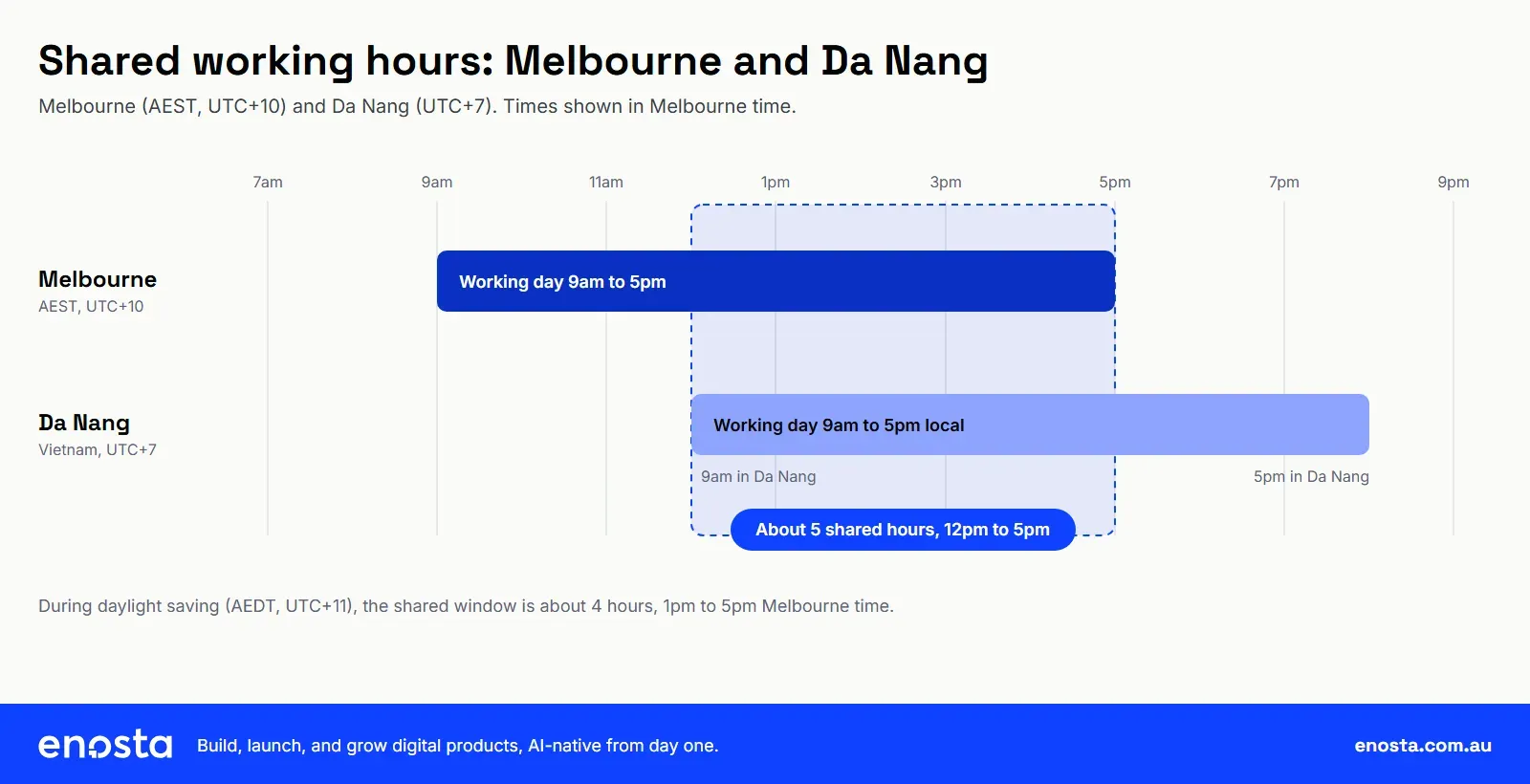
| Vietnam | 3 hours behind | Afternoon in Melbourne | Product development and dedicated teams |
| India | Four and a half hours behind | Late afternoon in Melbourne | Large teams and broad technology coverage |
| Eastern Europe | 8 to 9 hours behind | Little or none | Specialist skills with written handovers |
| Latin America | 13 hours or more behind | None | Rarely chosen from Australia because of the gap |
Each time-zone gap with AEST is shown in standard time. Gaps change by an hour when daylight saving starts or ends in either country. Melbourne moves to AEDT (UTC+11) in summer, while Vietnam stays on UTC+7 all year.
Time-zone overlap changes how you work, not only when you meet. With a shared afternoon, you can hold a short daily call, answer questions the same day and review a demo together. Without overlap, every question waits a day, so the written brief, acceptance criteria and handover notes carry far more of the load.
A few practical points help you compare destinations:
- Vietnam: A growing pool of software engineers, an afternoon overlap with the east coast and a strong record in product development and dedicated teams.
- Philippines: Close hours and strong English, often used for support, testing and back-office work alongside development.
- India: A very large talent pool covering almost every technology, with a shorter shared window than Vietnam or the Philippines.
- Eastern Europe: Strong specialist engineering, but almost no shared hours with Australia, so work must run on written handovers.
The right destination depends less on the country and more on the partner. A well-run team with a few hours of overlap beats a poorly run team in the same time zone.
Which engagement model fits
The engagement model sets how scope, cost and team are managed. There are three common models:
- Project-based outsourcing: The partner delivers an agreed scope, often for a fixed price. It fits a clear first release, such as an MVP with known features.
- Dedicated team: A stable team works on your roadmap full time, usually on time and materials. It fits ongoing product development where priorities change.
- Staff augmentation: Individual engineers join your existing team and follow your process. It fits a strong in-house team that needs extra hands or a missing skill.
A quick way to choose is to look at scope and duration. Clear scope with a fixed end suits a project. A long roadmap suits a dedicated team. Gaps in a working team suit staff augmentation.
Models can change over time. Many products start as a fixed-price MVP, then move to a dedicated team once the product is live and the roadmap keeps changing. Agree in the first contract how that switch would work, including who stays on the team and how knowledge carries over, so the move does not reset the relationship.
Find the model that fits your project
Tell us the scope and timeline, and we will map it to a project, a dedicated team or a mix.
Benefits, risks and how to manage them
Every benefit of outsourcing comes with a matching risk. Each risk has a control you can ask for in the proposal and the contract:
- Time-zone differences: Agree core overlap hours, a daily written update and a named contact on both sides.
- Communication and language: Meet the actual team before signing, and use written acceptance criteria for every feature.
- Quality and consistency: Require code reviews, automated tests and a demo of working software at the end of every sprint.
- IP and security: Put IP assignment in the contract and keep the repository and cloud accounts in your name.
- Less direct control: Get full access to the backlog, the code and the deployment pipeline from the first week.
- Hidden costs: Ask what is excluded from the quote, such as project management, testing, infrastructure and support after launch.
Most problems with outsourcing come from missing structure rather than distance. Teams that share the backlog, review code together and demo working software every sprint tend to catch issues while they are still small.
A partner who resists any of these controls is a warning sign. A good partner will usually suggest them before you ask, because they protect both sides.
How to outsource software development, step by step
A clear process keeps quotes comparable and risks visible. Each step below produces something you can check.
- Write the brief: Describe the users, the problem, the first release, constraints, integrations and budget range. You end up with a two to four page brief.
- Build a shortlist: Pick three to five partners with similar work and a time-zone overlap you can live with. You end up with a shortlist with reasons.
- Ask for proposals on the same brief: Request the approach, team, timeline, assumptions and exclusions. You end up with proposals you can compare line by line.
- Meet the team: Interview the engineers and the delivery lead who will work on your product. You end up with notes on communication and technical depth.
- Run a paid pilot: Deliver a small, real piece of work end to end. You end up with working software and a view of how the team works.
- Sign the contract: Cover scope, IP, data, security, payment, change requests and exit. You end up with a signed agreement reviewed by your lawyer.
- Onboard and deliver: Set up accounts, backlog, delivery cadence and acceptance rules. You end up with regular demos of working software.
- Plan handover: Keep documentation current and agree how knowledge moves to your team or a new partner. You end up with a handover plan you could use at any time.
How to choose an outsourcing partner
Choose a partner on evidence you can check, not on the sales pitch. Ask these questions and look for specific answers:
- What similar products have you built, and what was your part? Relevant work matters more than size. A good answer names the scope and the team's role, not only the client logo.
- Can we meet the engineers who will work on this? A good partner introduces the actual team before you sign.
- How do you handle security and access? Ask about their security posture. Look for certifications such as ISO/IEC 27001, named access and fast offboarding.
- How do you document and transfer knowledge? Knowledge transfer decides how easily you can change teams later. Expect a clear answer on documentation, onboarding and handover.
- What happens when an estimate is wrong? Listen for how the team raises problems early and agrees changes.
- Can we speak to past clients? References should talk about communication and delivery, not only results.
Ranked lists help you build a shortlist, but they do not replace these checks. Score each partner on the same questions, and weigh the pilot result above the proposal. A team that delivers a clean pilot and raises problems early is a better bet than the lowest quote.
Compare partners on the same terms
Send every vendor the same brief, and ask us for a fixed quote within 48 hours to compare.
Protect your IP, data and exit
The contract and the account set-up decide who controls the product if the relationship ends. Use this checklist with your lawyer before you sign:
- IP assignment: The contract assigns all IP in the code, designs and documents to your company on creation or on payment.
- Accounts in your name: Keep the code repository and cloud accounts in the client's name, together with domains and app store accounts, from day one.
- Confidentiality: A confidentiality clause covers your business information and any customer data.
- Personal information: If an overseas partner will access personal information, the OAIC guidance on APP 8 explains that you must take reasonable steps so the recipient does not breach the APPs. Under s 16C of the Privacy Act 1988, your company can remain accountable for the recipient's handling, subject to exceptions.
- Security controls: The partner limits access to named people, removes access when people leave and reports incidents promptly.
- Exit and handover terms: The contract sets a notice period, a handover of code, documentation and credentials, and support during the transition.
This is general guidance, not legal advice. Get legal advice on your contract, especially when personal information is involved.
Make the first 90 days work
The first three months set the habits that decide whether outsourcing works. Most of those habits sit on the client side, so plan your own time as carefully as the partner's.
Stage 1: Weeks 1-2, set up ownership and tools
Name a product owner on your side who can make decisions quickly. Create the repository, cloud accounts and backlog in your name and give the team access. Agree the sprint cadence, meeting times and how acceptance works. Use shared tools for the backlog, code and documentation, so both sides see the same status.
Stage 2: Weeks 3-6, run a paid pilot
Choose a small but real piece of the product and deliver it end to end, such as one user journey with its screens, API and tests. Judge the pilot on working software, code quality, communication and how the team handles a surprise. Keep the scope small enough that you can change partner if the pilot fails. Pay for the pilot, so the team treats it as real work and you own the result.
Stage 3: Weeks 7-12, settle the cadence and review
Hold a demo of working software at the end of every sprint, with the people who will use the product in the room when possible. Review the code, the test coverage and estimates against actual delivery. Look for these signs it is working:
- Estimates and delivery are close, and gaps are explained early.
- The team raises problems and questions without being asked.
- You can deploy and run the product without the partner's help.
This is how Enosta's Product Build and Scale service works. Delivery is led from Melbourne with engineers in Da Nang, Vietnam, under an ISO/IEC 27001 certified information security system. For a new product, the AI-Native MVP Development service aims for a production-ready first version in 2 to 3 months. Clients own the code, documents and cloud accounts from day one.
Get a team that builds and hands over
Talk to a Melbourne-led team about your product, your timeline and how ownership works.
Frequently asked questions
How much does it cost to outsource software development?
Cost depends on scope, team size, seniority, model and duration. Compare quotes only when every vendor has priced the same brief, and ask what is included, such as testing, project management and support after launch.
Is outsourcing a good idea for an early-stage startup?
It can be, if a founder or product lead owns the product and the first release is clearly defined. Without that, spend time on discovery and validation before paying for a build.
Can we outsource only part of a project?
Yes. A common approach is to outsource one product, one module or one capability, such as testing or a mobile app, while the core team stays in-house. Clear interfaces and shared standards make this work.
Can we bring development back in-house later?
Yes, if the contract and set-up allow it. Keep the repository and accounts in your name, require documentation, and agree a handover period in the contract from the start.