

AI governance is the set of owners, rules and checks that decide how an organisation picks, builds, buys and monitors AI. It matters in Australia now because new privacy duties are coming and national guidance is voluntary, so each organisation must set its own standard. This guide covers the rules and their status, a seven-part framework, what an AI policy should contain, where ISO/IEC 42001 fits and a three-stage path to start.
What AI governance means
AI governance is the system that makes someone accountable for every AI tool and decision in your organisation. It sets who approves new uses, which uses are allowed and how people stay in control. It sits next to two related ideas, and the differences matter when you assign work.
- AI governance: The operating system for AI use, covering accountability, oversight, testing and incident handling.
- AI ethics: The values behind that system, such as fairness and transparency. Ethics says what is right, and governance makes a named person responsible for it.
- Data governance: The rules for data quality, access and retention. AI governance relies on it but also covers models, tools and decisions.
Australian organisations are still early in building this system. The 2025 Australian Responsible AI Index surveyed 418 respondents who develop or deploy AI. The mean score for Australian organisations was 43 out of 100, one point lower than the previous year. The survey is self-reported, so read it as a signal rather than a census.
The gap shows up in ordinary situations. A staff member pastes customer details into a public chatbot, or a supplier quietly adds an AI feature to a tool you already use. Governance gives each case a named owner, a rule to apply and a record that it happened.
In the 2025 index, 25% of surveyed organisations had clearly designated roles with AI responsibility, the least implemented practice measured.
Accountability means a named person answers for each AI use. Oversight means a person can review, correct or stop what the AI produces before it affects a customer or a decision. Without both, a policy is only a document.
Naming an owner is the cheapest gap to close, which is why the framework below starts with roles. The rules that apply come first, because they set the minimum you must meet.
The Australian rules and guidance in 2026
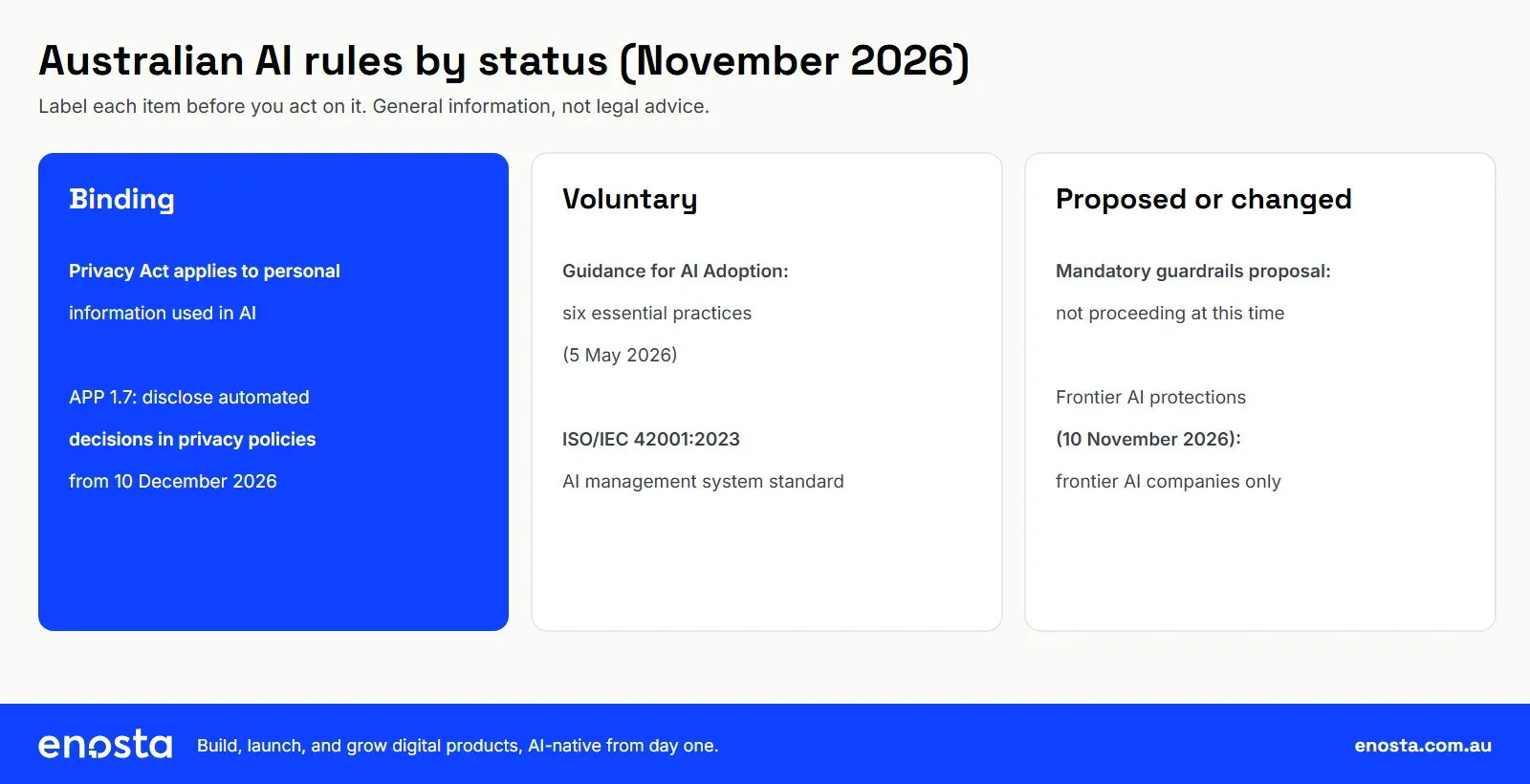
Australia has no single AI Act that covers every business, but existing law still applies to AI. The National AI Centre's page on AI and Australian law points to privacy, consumer, discrimination, work health and safety, and directors' duties. This is general information, not legal advice. The status below is as at 25 November 2026.
- Binding, privacy: The Privacy Act already applies to personal information put into an AI system and to AI output that contains it, according to the OAIC guidance on commercially available AI products.
- Binding, automated decisions: From 10 December 2026, APP 1.7 requires a privacy policy update if a computer program makes, or substantially helps make, a decision that could significantly affect an individual. This applies if the Privacy Act applies to you.
- Voluntary: The National AI Centre's Guidance for AI Adoption, published 5 May 2026 in two versions, sets six essential practices: decide who is accountable; understand impacts and plan accordingly; measure and manage risks; share essential information; test and monitor; maintain human control.
- Proposed or changed: The government will not proceed at this time with the mandatory guardrails proposal for high-risk settings. On 10 November 2026, the Prime Minister announced legislated protections for frontier AI companies only, with details to come.
The two versions of the guidance suit different teams. The foundations version is for teams starting out or using AI in low-risk ways. The implementation guidance is for teams that build or customise AI systems, manage higher-risk uses or need stronger controls.
The National AI Plan, published on 2 December 2025, says existing technology-neutral laws can already apply to AI. It also says the six essential practices will underpin new government tools and resources. The frontier AI announcement does not create a general regime for businesses that use AI. Rules in this area move fast, so check the Department of Industry, Science and Resources and the Prime Minister's site before you rely on this list. This is general information, not legal advice, so check your own obligations with a lawyer.
A seven-part AI governance framework
A working setup has seven parts, and each needs an owner, a written artefact and a first action you can finish this month. The table maps each part to the six essential practices. The mapping is an interpretation, not an official crosswalk.
| Component | Owner | Artefact | First action | Maps to |
|---|---|---|---|---|
| Roles and accountability | Executive sponsor | Named owner and decision rights | Appoint a senior leader as AI governance owner | Decide who is accountable |
| AI inventory and risk rating | Operations lead | AI register with a risk tier per use | List every AI tool and use, including automated decisions that use personal information | Understand impacts and plan accordingly |
| Policy | Governance owner with legal advice | AI policy | Publish rules for approved tools and data | Share essential information |
| Human oversight | Business process owner | List of decisions a person must approve | Mark which outputs need human review before use | Maintain human control |
| Testing and monitoring | Technical lead | Test plan and monitoring log | Test before launch and set a review schedule | Test and monitor |
| Incident handling | Security or risk lead | Incident process | Name who is told when AI output causes harm | Measure and manage risks |
| Vendor management | Procurement or IT lead | Supplier checklist | Run privacy due diligence before adopting any AI product | Measure and manage risks |
Testing and monitoring cover the whole life of a use, not just launch. Test before deployment, then monitor afterwards, because tools, data and staff habits change. Incident handling needs a named contact and a log of what happened, which data was involved and what changed, so the same failure is not repeated.
Rate each use by what it does, not by which tool it runs on. A hypothetical example: An assistant that drafts internal meeting notes sits in a low tier, while a tool that screens job applicants sits in a high tier. High tiers get named human approval, stricter testing and a closer review cycle. Low tiers need only a register entry.
Vendor management carries the most privacy exposure for a typical organisation, because staff adopt commercial tools quickly. The OAIC expects due diligence before adoption, an updated privacy policy and notifications that explain AI use, and a privacy impact assessment. Public-facing tools such as chatbots should be labelled so people know they are dealing with AI.
Find where AI already runs in your business
Enosta's AI Strategy: Audit and Roadmap service gives leaders an AI audit and roadmap before they invest, so governance starts from a real inventory.
What to put in an AI policy
An AI policy tells staff what they may do with AI and who decides when the answer is unclear. Keep it short enough that people read it, and link it to the register so it stays current. A strong draft covers these sections:
- Purpose and scope: Which people, tools and uses the policy covers.
- Approved and banned tools: The list staff may use, and the ones they may not.
- Data and personal information rules: What may be entered into each tool.
- Human review before use: Which outputs a person must check before they leave the building.
- Disclosure to customers: When and how you tell people AI was involved.
- Incident reporting: Who to tell, how fast and where it is logged.
- Training: What staff learn before they get access.
- Review cycle and owner: Who updates the policy and how often.
The data rules deserve the most care. The OAIC treats it as best practice not to enter personal information, especially sensitive information, into publicly available generative AI tools. Write that rule in plain words and name the approved alternatives. Keep the policy to a few pages and point to the register for detail, so a change to a tool does not force a rewrite. Where the policy touches customers, align it with your privacy policy, which must explain AI use in clear terms.
Where ISO/IEC 42001 fits
ISO/IEC 42001:2023 is the international standard for an AI management system. It specifies requirements for establishing, implementing, maintaining and improving that system in organisations that provide or use AI. ISO published it in December 2023, and Standards Australia adopted it as AS ISO/IEC 42001:2023 in February 2024. It is a voluntary standard, not law.
The standard covers leadership and policy, AI risk assessment and treatment, AI system impact assessment, operation, monitoring and internal audit. Its Annex A controls include AI policy, roles, data quality, logs, human oversight and suppliers.
Pursue it when one of these applies:
- Customers or tenders ask for it: Certification gives buyers independent evidence of how you manage AI.
- You build AI products: A formal system suits teams that ship AI to other people.
- You already run ISO/IEC 27001: The standards share a harmonised structure, so existing documents and audits can carry over.
Enosta is certified to ISO/IEC 27001:2022, not to ISO/IEC 42001. Organisations with an existing security management system can reuse its structure for AI, but they still need AI-specific risk and impact work. If no customer or regulator is asking, the seven parts above are a sound place to stop for now. Certification adds audit work and ongoing upkeep, so wait until a buyer, tender or product plan gives you a clear reason to take it on.
Move AI projects forward with clear rules
Fixed quotes arrive within 48 hours, so you can scope governance work next to the build instead of after it.
How to start: a three-stage path
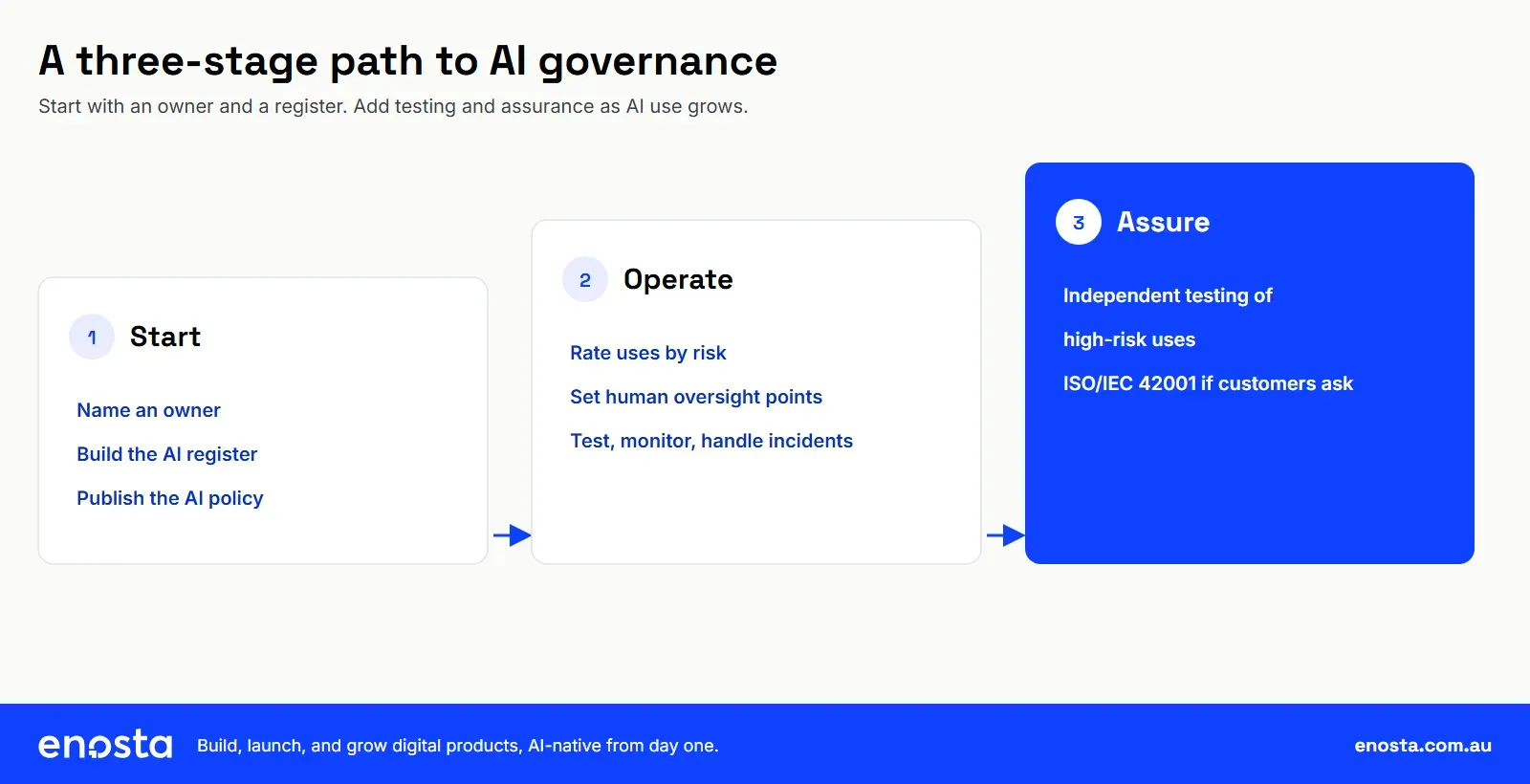
You do not need a large programme to begin. Order matters more than scale, because an owner without a register has nothing to govern and a policy without an owner has no one to enforce it. A start, operate and assure path suits small and mid-sized organisations, because each stage builds on the one before it.
- Start: Name an owner, build the AI register and publish a short policy. The 2025 index shows designated roles are the practice organisations most often leave undone.
- Operate: Assign risk tiers, set the points where a person must approve an output, test before launch and monitor afterwards, and agree an incident process. Review the register whenever a team adopts a new tool.
- Assure: Add independent testing of your highest-risk uses, and consider ISO/IEC 42001 if customers or tenders ask for it. Report results to the executive sponsor so the owner keeps authority.
Two services fit this path. AI Strategy: Audit and Roadmap suits the start stage, where you need to see current AI use before writing rules. Agentic Workflow Automation suits teams that want automation with controls designed in from the first workflow.
Automate with controls built in
Agentic Workflow Automation is scoped around your oversight points, and clients own the code, documents and cloud accounts from day one.
Frequently Asked Questions
Does a small business need AI governance?
Yes, but a light version, sized to how you use AI. A small business still needs a named owner, a list of the AI tools in use and a short policy. If the Privacy Act applies to you, privacy duties cover personal information put into AI tools. The guidance has a foundations version for teams that are new to AI governance.
Who should own AI governance?
A senior leader should own it, because the Guidance for AI Adoption lists assigning a senior leader as AI governance owner among its first actions. The role needs authority to approve or stop AI uses. Legal, IT and operations then support the owner rather than share the accountability. The owner should report to the executive sponsor and meet the people who run each AI use.
Can staff use ChatGPT at work?
They can if your policy approves the tool and sets data rules. The OAIC treats it as best practice not to enter personal information into publicly available generative AI tools. Tell staff which tools are approved, what data stays out and who to ask when they are unsure.
How long does ISO/IEC 42001 certification take?
No verified timeline exists in the sources reviewed for this guide, so any figure would be a guess. Effort depends on your scope, how mature your current management system is and whether you already hold ISO/IEC 27001. Ask a certification body for a scoped estimate before you commit.