

The product life cycle is the path a product follows from launch to withdrawal, through introduction, growth, maturity and decline. Each stage changes sales, costs and competition, so each one calls for a different decision. For software products, decline often means ageing technology rather than falling demand, so the choice is often to modernise or retire. This guide sets out the stages, how to place your product and what to do at each one.
What the product life cycle is
The product life cycle describes how a product's sales and profit change over time, from launch to withdrawal. It is a management tool, not a forecast. Leaders use it to decide where to invest, when to defend a position and when to stop.
The classic model has four stages: introduction, growth, maturity and decline. Theodore Levitt wrote "Exploit the Product Life Cycle" in Harvard Business Review in November 1965. He argued that marketing executives knew the concept well but rarely used it as a management tool.
Some models add a development stage before launch, which gives the five-stage model used in this guide. Others add saturation, the point where the market is full and growth stops, between maturity and decline. The count matters less than the decision each stage demands.
For software teams, the model guides how to split effort between new features, scaling work and upkeep. A product in introduction needs learning from users, while a product in maturity needs protection of margin and renewals. Using one playbook for every stage wastes budget.
The product life cycle is not the product development life cycle, which covers how a team builds a product. The FAQ at the end explains the difference.
The stages at a glance
| Stage | Sales | Costs and profit | Competition | Main decision |
|---|---|---|---|---|
| Development | None | Costs rise with no revenue, so profit is negative | None yet | Whether to build, and how small the first version can be |
| Introduction | Low and slow | Acquisition and support costs are high, and profit is negative or near zero | Few rivals, if any | Whether early users stay and the product fits the market |
| Growth | Rising fast | Cost per customer falls and profit turns positive | New entrants arrive | How to scale the product and team without losing quality |
| Maturity | Peak, then flat | Profit is at its highest, but acquisition costs climb | Crowded, with price pressure | Whether to defend, extend or modernise |
| Decline | Falling | Margins shrink while upkeep costs remain | Rivals and substitutes take share | Whether to renew, redirect, harvest or retire |
Treat these rows as a pattern, not a schedule. Sales usually rise, peak and fall, while profit tends to peak after sales growth slows, because early costs have been paid back. The right move at one stage can be the wrong move at the next.
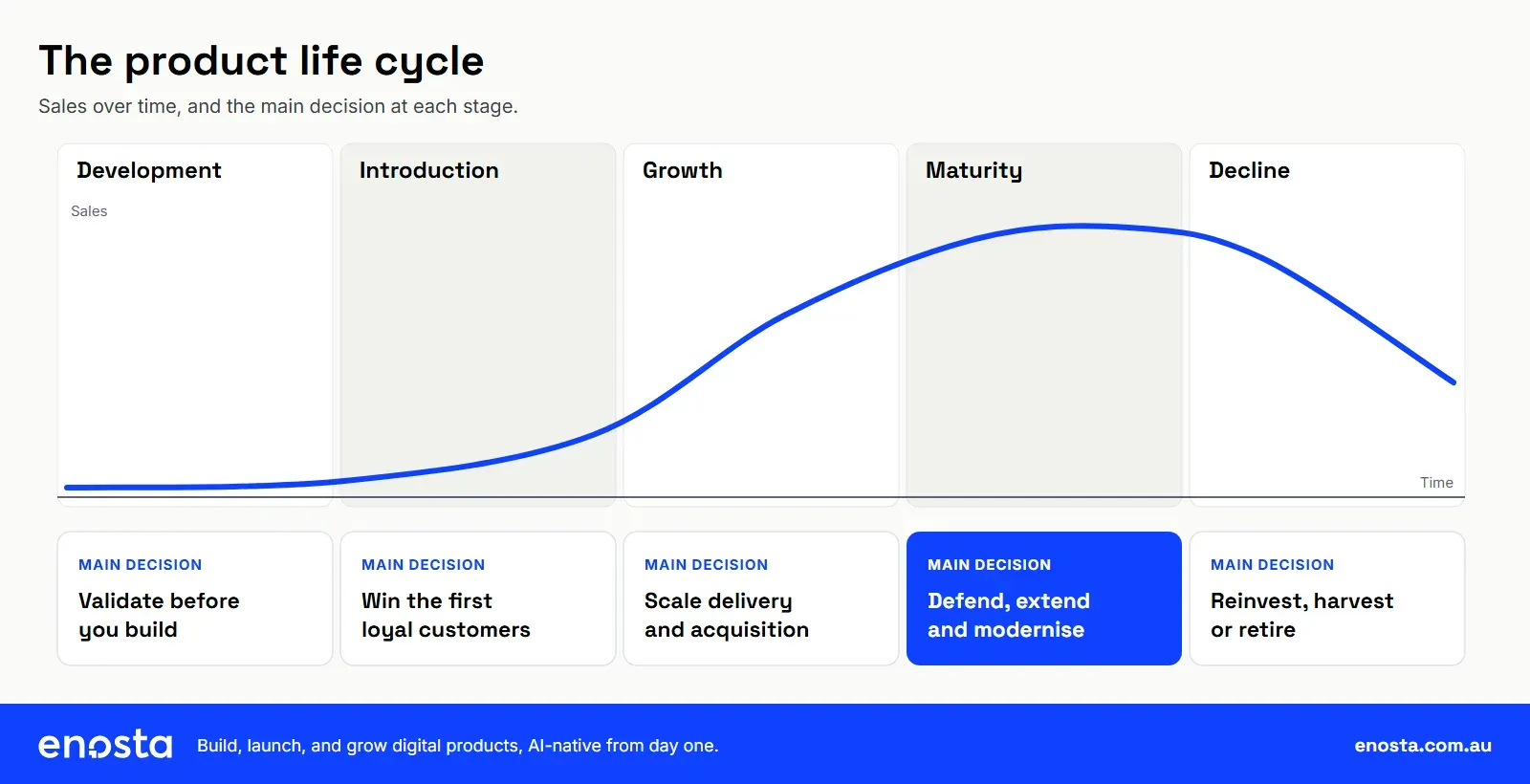
The five stages for software products
For software, the useful signals are churn, renewals, customer acquisition cost, price pressure and security support, not unit sales on a shelf.
Development
What happens: The team researches the problem, tests ideas and builds a first version. Costs run with no revenue, and the aim is a minimum viable product (MVP) that real users can try.
Signals: Spend rises while customer numbers stay at zero. Technical debt starts here, because early shortcuts in architecture and code are cheap to take and costly to fix later.
Main decision: Whether to build at all, and how small the MVP can be while still testing the riskiest assumption. A narrow first release reaches real users sooner and lowers the cost of being wrong.
Introduction
What happens: The product reaches its first real users. Sales are low, customer acquisition cost is high and the team fixes problems found in live use. Churn can be high because early users are still testing fit.
Signals: Sign-ups grow slowly, trial users leave within weeks and support requests are frequent. Revenue does not yet cover running costs, and few competitors exist.
Main decision: Whether users stay and pay. Keep improving the core job until churn falls, and hold back wide marketing spend until it does. Paying to attract users who then leave only widens the loss.
Growth
What happens: Sales rise quickly as word spreads and marketing starts to work. Rivals notice and enter, and prices begin to face pressure. Cost per customer falls as the product scales.
Signals: Renewals are strong, customer acquisition cost holds steady or falls, and new competitors appear in your sales conversations. Infrastructure strain shows up as slower pages and more incidents.
Main decision: How to scale the product, infrastructure and team without letting quality slip. Investing in architecture now avoids technical debt that slows later releases.
Maturity
What happens: Growth slows and the market fills. Profit is at its highest, yet each new customer costs more to win, and rivals compete on price and features.
Signals: Customer acquisition cost climbs, growth flattens and renewals matter more than new sign-ups. Discounting spreads, and technical debt starts to slow each release.
Main decision: Whether to defend share, extend the product's life or modernise the technology underneath it. Waiting usually moves the product toward decline.
Decline
What happens: Sales and active users fall because customers move to newer products, needs change or the technology ages. Profit shrinks because upkeep costs stay close to where they were.
Signals: Churn rises, renewals shrink and price cuts do not win customers back. Security support for key components ends, and engineers spend more time on fixes than on new work.
Main decision: Whether to renew, redirect, harvest or retire the product. The decline options below cover each choice.
Reach real users in 2 to 3 months
Our AI-Native MVP Development service delivers a production-ready first version in 2 to 3 months, so you learn from real users early.
How to tell which stage you are in
No single number places a product. Read five signals together, using data most software teams already track, and look at the direction over several quarters, not one month.
- Growth rate: Fast, rising revenue growth suggests growth. Flat growth suggests maturity, and a fall suggests decline.
- Churn: High churn in the first months suggests introduction and weak fit. Low, stable churn suggests maturity. Rising churn among long-standing customers points to decline.
- Competitor count: Few rivals suggests introduction. A fast-growing field suggests growth, and a crowded market of lookalike products suggests maturity.
- Price pressure: Premium pricing that holds suggests introduction or growth. Frequent discounting suggests maturity, and price cuts that fail to lift sales suggest decline.
- Technology age: A modern stack with low technical debt suggests an earlier stage. Unsupported components, slow releases and rising upkeep costs suggest late maturity or decline.
For example, a product with flat growth, rising churn and unsupported components points to decline, even while revenue is still high. A product with fast growth but frequent outages points to a scaling problem in growth, not a mature one.
If the signals disagree, trust growth rate and churn first, because they show customer behaviour. Competitor count and technology age tell you what is likely to come next.
How to extend a product's life
Extending the life cycle works best in late growth or maturity, before decline sets in. Five options run from lower effort to higher effort, and the cheaper ones are worth trying before the costly ones.
- New segment: Sell to a customer group the product does not yet serve, such as a new industry or company size. It needs few product changes but a new sales approach.
- New features: Add capabilities that bring lapsed users back or raise the value of each account. The risk is feature bloat that adds upkeep without adding renewals.
- Pricing change: Adjust tiers, packaging or contract terms to match how customers use the product. Test with new customers before you change existing contracts, so a mistake does not reach your renewals.
- Integration: Connect the product to the tools customers already use, so it fits their workflow and becomes harder to replace. Each integration also gives your team a new reason to talk to customers.
- Modernise: Rebuild or replace ageing parts of the system. It takes the highest effort, and it removes the technical debt that slows every other option.
Enosta's services map to these stages. AI-Native MVP Development suits introduction, with a production-ready first version in 2 to 3 months. Product Build and Scale suits growth, when custom software must handle more users and features.
Legacy Modernisation suits maturity and decline, because it modernises ageing systems without disrupting operations. Clients own the code, documents and cloud accounts from day one, and delivery is ISO/IEC 27001 certified.
Modernise without disrupting your customers
Legacy Modernisation updates ageing systems while operations keep running, and you own the code from day one.
What to do in the decline stage
Decline is not the end of every product. Five options cover the range, from renewing the product to closing it, and the right one depends on remaining demand and the cost of change.
- Innovate: Release a new version with better quality, improved features or added services. It fits when customers still value the core job but find the product dated. The risk is spending on features that do not change why customers leave.
- Diversify: Add related products or bundles for the same customers, so the business depends less on one product. It fits when you hold a loyal customer base. The risk is stretching the team across several products.
- Change direction: Reposition the product for a new industry or customer segment. It fits when the technology still works but the original market has shrunk. The risk is misreading the new market.
- Harvest: Stop major investment, keep the product running and collect the remaining revenue. It fits when a loyal group still pays and upkeep is low. The risk is security gaps and rising churn as the product ages.
- Retire: Close the product and move customers to a replacement or an alternative. It fits when demand has gone or upkeep costs exceed revenue. The risk is losing customers, so write a migration plan with end dates, data export and support.
To choose between the options, compare the revenue that remains, the cost to keep the product secure and supported, and the cost to change it. The option with the clearest return at an acceptable risk usually wins, and a rough comparison is better than a delay.
Windows 10 shows decline in software. Microsoft's Australian end-of-support page states that Windows 10 reached end of support on 14 October 2025. Extended Security Updates keep eligible PCs receiving important security updates until 12 October 2027.
The announced date gave customers time to plan, and the update programme bridged eligible PCs. Your own retirement plan needs a clear end date and a bridge for customers who cannot move yet.
Compare rebuild and retire costs first
A fixed quote within 48 hours gives you a clear cost comparison before you decide.
Where the model falls short
The product life cycle helps you ask better questions, but it cannot plan your year on its own. Three limits matter most, and each has a practical fix.
- The curve is a pattern: Because not every product follows the curve, some products rise again after a dip or fade quickly. Treat the curve as a hypothesis and test it against your own data.
- Length is uneven: Do not plan to a calendar, because stages vary in length by market, pricing model and pace of technology change. Compare your product with its own history, not an industry average. Review the stage every quarter and record the signals that led to your call.
- Self-fulfilling decisions: A team that labels a product mature may cut investment, and sales then flatten, which seems to confirm the label. Check churn and customer feedback before you cut, and ask whether a new segment or a rebuild could change the picture.
Frequently Asked Questions
How long does each stage last?
There is no standard length. It depends on the market, the pace of technology change and how well the product is maintained. A product that is updated regularly can stay in maturity for a long time, while one tied to ageing technology can decline quickly. Track your own signals instead of an industry average, and review them each quarter.
Can a product skip a stage?
In practice, yes. A product may reach maturity with little growth, or go from introduction straight to retirement when users do not stay. A product can also move back, for example from maturity to growth after it reaches a new segment or is rebuilt.
Is the product life cycle the same as the product development life cycle?
No. The product development life cycle covers how a team builds a product, from idea through design, build and testing. The product life cycle covers what happens to the product in the market after launch. The two meet only in the development stage.
Does the life cycle work differently for SaaS?
The stages are the same, but SaaS makes them easier to measure. Subscription revenue shows churn, renewals and customer acquisition cost month by month, so you can spot a stage change early. Continuous updates can extend maturity, yet technical debt still builds and can push a product into decline.